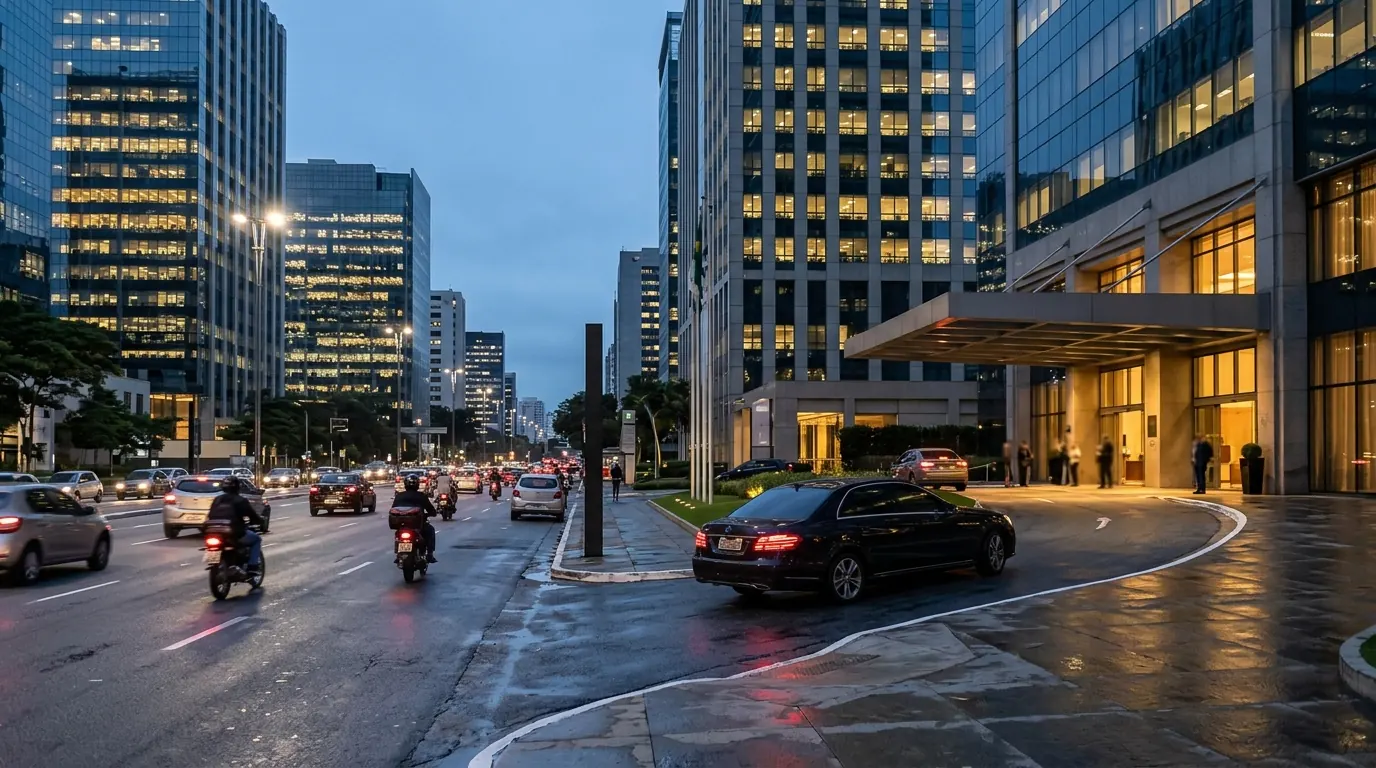
Your CFO lands at Guarulhos on a Sunday night for a Monday board meeting, and the hotel is already booked on the Faria Lima corridor, because every source you checked said that is where executives stay. Before you sign off on the arrival plan, it is worth asking one more question: does the car pull into the building, or does your principal cross open pavement to reach the lobby door?
Get that answer right and the CFO walks into the boardroom at nine o'clock exactly as planned. That question matters more than the neighbourhood, and the 2026 numbers show why.
Pinheiros is the district that carries much of Avenida Brigadeiro Faria Lima, the corridor almost every business-travel guide names first. Between January and May 2026 it recorded 1,473 robberies, the second-highest count of any district in São Paulo, and it rose 8% against the same period last year. Over that same stretch, robbery across the city as a whole fell 13%.
That is not an argument for avoiding Pinheiros. It is an argument that the neighbourhood is the wrong unit of measurement, and the people who publish the data agree.
A própria secretaria de segurança de São Paulo diz que o ranking não é válido
When G1's SP1 programme published its district ranking on 3 July 2026, drawn from Secretaria da Segurança Pública (SSP-SP) figures, the secretariat responded with an unusually direct caveat. Ranking neighbourhoods, it said, is not correct, "visto que cada região possui características populacionais, sazonais e geográficas distintas, que impactam diretamente os indicadores criminais": because each region has distinct population, seasonal and geographic characteristics that directly affect the crime indicators.
Read that carefully, because it is the most useful sentence published about São Paulo lodging this year. A district's robbery count rises with the number of people in it, the hours they spend on its pavements, the density of its commerce, and how reliably its victims file reports. Pinheiros has heavy daytime footfall, a dense restaurant and office economy, and residents who report. Those are the same qualities that make it attractive to stay in.
So a high count in a commercial district tells you about the denominator. It does not tell you what a single visitor's evening is likely to look like.
That reading does not rest on the SSP-SP numbers alone. Vanguard Attaché's own aggregation over public incident feeds points the same way. In the 30 days to 26 July 2026 it recorded 5,350 raw incident signals across Brazil, cluster-deduplicated to 5,296, of which 570 geocoded to the city of São Paulo and 65 were cross-referenced across two or more independent sources. Centro (13), Zona Sul (9), Brás (8) and Zona Leste (8) led that São Paulo leaderboard. Read the Brás figure with its defect attached: Brás and Tatuapé sit on the rail corridor that failed on 23 July 2026, a non-criminal infrastructure event, so those two counts are press volume rather than crime. Pinheiros (5) and Itaim Bibi (3), the two districts the Faria Lima corridor runs through, sit low on that board, well under Centro's 13 — and the Itaim Bibi count rests on a single incident, which is too thin to carry an argument. Capão Redondo (5), the district that topped the SSP-SP ranking above, sits at the same low level. These are incident signals recorded, not verified incidents, and not a client-engagement or operations count. What the second dataset does not show is a corridor standing out. That is the point: the corridor's high SSP-SP count is a statement about how many people pass through it, not about what happens to one of them.
The reverse trap is worse. Districts that international guides describe as "the safest" ranked below the top ten, and a lower rank is a statement about a district's total count, not about a visitor's exposure inside it. "Jardins" makes the problem plain: it is a colloquial name for an area spanning parts of Jardim Paulista and Cerqueira César, so it is not a unit any crime statistic is reported in. The label has been repeated between guidebooks for years without matching anything the data actually counts.
O que os números de São Paulo de 2026 realmente dizem
Three things are true at once, and holding them together is the whole skill.
First, the direction is genuinely good. The city of São Paulo recorded 98,358 general robberies in 2025, the lowest figure in its recorded history and the first time in 25 years the count fell below six digits. That is 14.6% down on the 115,172 robberies logged in 2024. Vehicle robbery fell 21% over the same period, from 12,559 to 9,921. SSP-SP reports robbery down a further 13% across the capital so far this year.
Second, the distribution is uneven, and not in the way outsiders assume. Here is the published ranking for January to May 2026:
| Distrito | Roubos (jan–mai 2026) | Direção |
|---|---|---|
| Capão Redondo | 1,623 | alta de 10% |
| Pinheiros (corredor Faria Lima) | 1,473 | alta de 8% |
| Campo Limpo | 1,247 | queda de 14% |
| Parque Santo Antônio | 1,181 | alta |
| Santo Amaro | 1,030 | alta de 34% |
| Sé (centro histórico) | 1,027 | queda |
| Perdizes | 909 | queda |
| Brooklin | 658 | queda |
| Vila Sônia | 569 | queda |
| Perus | 557 | queda |
Capão Redondo averages roughly ten robberies a day, one every two hours and fourteen minutes. Pinheiros, at 1,473 over the same 151 days, runs one every two hours and twenty-eight minutes; coverage of the survey reports two hours and forty-seven minutes for Pinheiros, which does not reconcile with the count it is derived from. Santo Amaro carries the sharpest rise on the list at 34%.
Note what that table is, and what it is not. It is the published top ten. The districts holding most of the city's executive hotel inventory, among them Itaim Bibi, Jardim Paulista, Moema and Consolação, sit below the tenth-placed district, Perus, at 557. That tells you where they rank. It does not tell you what a specific arriving principal is exposed to, and the distinction matters more than the ranking does. A district count measures a place across five months, aggregating everyone who lived, worked or passed through it. Your principal is not a place. They sleep in one district and work in another, and on a normal day they cross four or five of them. Choosing lodging by postcode does not take them out of the corridor where the meetings are. It adds a commute to it.
Third, the way people feel has not caught up, and that gap is itself information. Datafolha, polling 1,608 people across 71 municipalities of São Paulo state on 1 to 3 July 2026, found 47% of São Paulo state residents report high fear of being robbed in the street and a further 29% report some fear. Only about one resident of the state in four moves untroubled. Fear is falling (the 2022 wave found 57% in the highest category), but from a high base. Residents name the absence of police on the street as the leading problem, and the arithmetic supports them: 79,603 active military police in 2026, against 84,404 in 2001, serving a population that has grown by more than a fifth.
For you, that divergence has a practical meaning. Local staff, drivers and hotel employees are operating inside a climate of caution that the aggregate statistics no longer justify. That makes them useful sources of ground-level detail, and it also means their advice will skew conservative. Read it accordingly.
A exposição está na soleira, não no distrito
Here is where the neighbourhood framing does the most damage: it points attention at a map when the evidence points at a doorway.
Two incidents captured on camera in the same July week, both reported by GloboNews and G1 on 8 July 2026:
On 7 July, in Campo Belo in the south zone, security cameras recorded a woman leaving a residential condominium. A motorcyclist carrying a food-delivery backpack approached her, announced the robbery, took her wedding ring and rode off.
On 4 July, in Jardim Monte Alegre in the west zone, a motorcyclist robbed a couple on the street and took a ring. The motorcycle's licence plate had been covered with plastic to defeat identification.
Look at what those have in common. Not a district: Campo Belo and Jardim Monte Alegre sit on opposite sides of the city. What they share is a moment. Both happened in the seconds when a person was between a building and the open street, and in both the approach used the most ordinary sight in São Paulo as cover: a motorcycle with a delivery bag on the back.
This is what we mean by the threshold, the short crossing between the car door and the lobby door, and it is where an executive's exposure concentrates. It is also the one part of a trip that repeats. A four-night stay produces at least eight threshold crossings at the hotel alone, each at a predictable place, most at a predictable time. Manage that crossing well across all eight and the stay disappears into the schedule: the meetings start on time and nobody remembers the arrival at all.
The target class is specific too. Ring and jewellery robbery in the city of São Paulo ran to 84,700 recorded cases in the first half of 2026, an average of 471 a day, close to 20 an hour. Statewide the figure was 195,500 cases, down 24.1% from 257,500 in the first half of 2025. The direction is improving. The volume is still such that a visible wedding band at a hotel entrance is a genuine and quantified target.
Por que não publicamos um ranking de segurança de hotéis
The obvious thing to write here would be a scored list of São Paulo hotels. We are not going to, and the reason is worth stating plainly.
We have not found a public dataset that supports property-level security claims, and we looked: no audit we can locate records which São Paulo hotels have a garage door that closes behind a vehicle, which ones set their entrance back from the traffic lane, or which ones run a delivery protocol at the guest entrance. If one exists we would use it. What is easy to find are lists that score hotels on brand, price and review sentiment, and call the result safety.
We direct executive movements in this city. What we can give you is the assessment we actually run, in a form you can run yourself on any property, in any district, using a phone call and a satellite image.
That is more useful than a list anyway. Lists go stale. Criteria do not.
O scorecard do envelope de chegada
Score the property out of 10. At 7 or above, the car-to-lobby crossing all but disappears and the week's meetings run on schedule; that is a strong executive base in any of the central-southwest districts. Below 4, the district will not rescue it.
1. Can the vehicle enter a controlled space before the principal steps out? (0 to 3 points)
Three points if the car passes into an enclosed garage or courtyard and a door or gate closes behind it. Two if there is a covered porte-cochère set back from the traffic lane, with the entrance under staff observation. One if the drop is a flush kerbside stop on a public pavement. Zero if the drop is on a busy avenue with no setback. This single criterion carries the most weight, because it determines whether the threshold crossing happens in public at all.
2. Can the principal reach the room from the vehicle without re-emerging? (0 to 2 points)
Two points if the garage or courtyard connects directly to a lift lobby inside the secure line. One if it requires a short internal walk through a controlled area. Zero if the guest must exit onto the pavement and re-enter through the main door. Ask the hotel directly. The answer is usually given without hesitation, because it is an architectural fact rather than a security disclosure.
3. Is there more than one usable face to the building? (0 to 2 points)
Two points if there is a separate service, garage or side approach that can be used on a different day from the main entrance. Zero if the only way in is the door the public uses. We call this the single-face problem: when arrival and departure collapse into one door, the pattern becomes observable to anyone who watches the building for two mornings. A second face is what lets a movement plan vary.
4. Does the entrance have standing staff presence, and a delivery protocol? (0 to 2 points)
Two points for a staffed entrance with a defined process for couriers and deliveries that keeps them away from the guest threshold. One for staffed but undefined. Zero for an unstaffed lobby entrance. Given that the July incidents both used delivery-rider cover, this criterion has stopped being theoretical.
5. Where does the property sit relative to your actual meeting schedule? (0 to 1 point)
One point if the majority of the week's meetings are reachable without crossing the city at peak. Zero otherwise. This is a security criterion, not a convenience one: every additional peak-hour crossing is more time in slow or stopped traffic, which is where vehicle-side approaches happen.
Run that on two properties 400 metres apart on the same avenue and you will frequently get different scores. That difference is real, and it is invisible to every neighbourhood ranking published.
O que um travel manager controla e o hotel não
Three of the strongest levers are not property features at all, and all three are aimed at the same outcome: every stop on the week's schedule gets reached without the trip becoming a story.
What is worn at the door. Given roughly 20 ring and jewellery incidents an hour in the city, the highest-yield instruction you can pass to a principal is about the threshold, not the itinerary: watches and rings go on inside the vehicle or inside the building, not on the pavement. It is a small ask and it addresses the single most quantified target class in the data.
Predictability. A stay that departs from the same door at 08:10 every morning is a pattern. Varying departure time by fifteen or twenty minutes, and alternating the face of the building where a second one exists, costs nothing and removes the observability that a threshold approach depends on.
Which airport, and therefore which approach. Congonhas sits close to the Moema, Vila Olímpia and Faria Lima band, and a transfer from it is short. Guarulhos is a longer run from the north-east of the metropolitan area, and the approach is mostly expressway, where the exposure profile is lower than dense urban streets. Plan the buffer to the airport, not to the neighbourhood. We treat the journey times we work to as our own planning ranges, because we have found no published time series for these specific routes, and we are not going to present an estimate as a statistic.
O que você realmente recebe: uma reunião alcançada no horário, sem exposição na calçada
What you are really buying is not the absence of an incident: that is unfalsifiable. It is a Monday morning boardroom slot on the Faria Lima corridor, reached on schedule, with your principal never standing on open pavement.
That comes from lodging chosen on its arrival envelope rather than its postcode, a vehicle that enters the controlled space before your principal moves, and a movement desk with same-day reroute authority if the day changes. Vanguard Attaché is the accountable directing operator behind that outcome. We set the plan and command it, so the arrival envelope, the departure-pattern variance and the reroute authority function as one system rather than three separate vendors. Where an assessment calls for a regulated armed component, it is delivered by licensed Brazilian partners operating under our direction and under their own authorisation.
That is the difference between a hotel that is well reviewed and a stay that reaches the boardroom on time.
Antes de confirmar a reserva
Five questions, all answerable by phone or email in a single exchange:
- Does the guest vehicle enter an enclosed garage or a set-back covered entrance, and does anything close behind it?
- Does the garage connect to a lift lobby without the guest returning to the pavement?
- Is there a second usable entrance, and can a returning guest be brought in through it?
- Is the main entrance staffed at all hours, and what is the process for deliveries?
- What is the realistic door-to-door time to the addresses on the week's schedule at 08:00, not at midday?
If a property answers the first four cleanly, the district on its address becomes a much smaller factor in your decision.
Pronto para Garantir Segurança na Sua Viagem?
Complete nossa avaliação de segurança para receber um plano de proteção personalizado, montado a partir do seu roteiro, dos seus destinos, do seu perfil de risco e das suas datas de viagem.