Vanguard Attaché’s quarterly read on what actually moves executive-travel risk in Brazil, fusing the official public-safety record with our own multi-source monitoring layer. Edition 1 · data through 12 July 2026.
The three numbers that change how you move this quarter
1. Brazil is, in aggregate, less lethal than it has been in over a decade. The country recorded an intentional-violent-death rate of 20.8 per 100,000 in 2024, its lowest since 2012: a 5.4% fall on 2023, across 44,127 violent deaths and 35,365 intentional homicides (19º Anuário Brasileiro de Segurança Pública, Fórum Brasileiro de Segurança Pública, 2024 reference year).
2. Our own monitoring picture is denser than any annual table can be. Vanguard Attaché’s GSOC monitoring layer ingested 2,639 raw incident signals and cluster-deduplicated them to 2,505 across its Brazil feeds in the 30 days to 12 July 2026, with 190 geocoding to São Paulo city and 348 to Rio de Janeiro, plus 15 signals concentrating on a single Rio community (Rio das Pedras) and 13 on the Jacarepaguá operations belt. That corridor-level, same-month resolution is exactly what a once-a-year national figure cannot give a traveller.
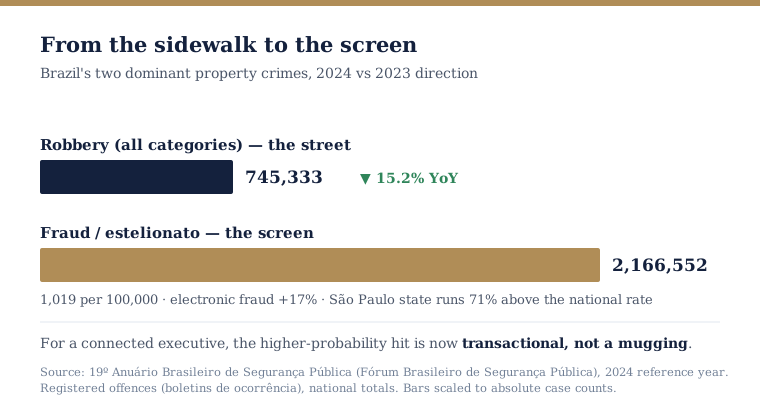
3. The risk that grew is the one most travel policies ignore. Street robbery fell hard, with roubos down 15.2% to 745,333 in 2024 and pedestrian robberies off 22.6%. Over the same year fraud (estelionato) climbed to 2.17 million cases at 1,019 per 100,000, overtaking robbery as Brazil’s dominant property crime, and running 71% above the national rate in São Paulo state (19º Anuário FBSP). For an executive, the threat vector moved from the sidewalk to the phone.
Read together, these say something the headline “Brazil is getting safer” misses. The average is improving. The shape of the risk an executive actually carries is concentrated, corridor-specific, and increasingly digital, and that is not something an annual national average can price. Closing that gap is what this Snapshot exists to do.
Why a firm that directs the operation reads it differently
Most Brazil risk reporting is an annual national table produced by someone who will never stand in the corridor. Vanguard Attaché reads that table too, and also runs the operation. We are the directing operator: we own the intelligence, the planning, the protective command, and the secure transport end to end, and the regulated armed component is executed under our direction by Polícia Federal-authorized local partners. Because we coordinate the movement, our monitoring layer is built around the question a principal actually asks, is my corridor, this week, moving in the right direction?, not around a calendar-year rate. The Snapshot is that operating view, made legible.
The official baseline, read as an operator would
The public record for 2024 says two things at once, and an executive-travel plan has to hold both. The national trend is genuinely better: intentional violent deaths fell to the lowest rate since 2012, and 22 of 27 federal units saw their lethal-violence rate decline. But a national average is the wrong instrument for a single principal on a fixed itinerary, and it hides the two facts that actually change a movement plan.
The first is that the improvement is not evenly shared. São Paulo was one of only four states where the intentional-violent-death rate rose (up 7.5%), so the country’s largest business destination moved against the national trend. A plan that prices São Paulo off the national number under-prices it.
The second is that the kind of crime an executive is exposed to has inverted. The registered burden of street crime is falling across the board: pedestrian robberies down 22.6%, commercial-establishment robberies down 24.4%, cell-phone robbery and theft down 12.6% nationally. In the same year fraud rose 7.8% to 2.17 million cases, with electronically-committed fraud up 17%. The Fórum Brasileiro de Segurança Pública calls this “the consolidation of a new tendency” in Brazilian property crime. For a connected traveller it is simpler than that: the crime that is receding is the one your driver protects you from, and the crime that is growing reaches you through a screen you carry.
State and city series carry the detail a national figure smooths over. São Paulo’s SSP-SP publishes monthly robbery, latrocínio and homicide tables and its SPVida lethal-crime panel; Rio de Janeiro’s ISP-RJ publishes monthly series statewide and by police area, and has reported historically low street-robbery counts in recent quarters. A Snapshot edition reads the current month of each, not last year’s summary.
The proprietary lens: what our monitoring layer adds
The official series is authoritative and slow. Our monitoring layer is granular and current. In the 30 days to 12 July 2026, Vanguard Attaché’s GSOC layer aggregated signals from three independent feeds (news/RSS, Instagram, and Fogo Cruzado; GDELT rows are excluded from the counts), deduplicated them by cluster, and geocoded them. Of the signals, 696 were Instagram-sourced and 334 came from Fogo Cruzado, the kind of multi-source blend a single search query cannot reconstruct. Fifty of the 2,505 deduplicated signals cleared a two-independent-source cross-reference bar; the rest are monitored signal, not verified incident, and we never present them as more than that.
Vanguard Attaché GSOC monitoring layer
Brazil feeds, 30 days to 12 July 2026
Source: Vanguard Attaché GSOC monitoring layer. Monitored incident signals, not verified incidents, and not a measure of client engagements.
Correction, 7 October 2026. The GSOC figures on this page previously counted GDELT rows, which are templated event-code rollups placed at map centroids rather than distinct incidents. They have been recomputed over the same window and the same ingested data with GDELT excluded; the counts now cover news/RSS, Instagram and Fogo Cruzado rows de-duplicated on cluster key.
What the aggregate buys a traveller is concentration. The Rio de Janeiro signal did not spread evenly. It clustered on the Rio das Pedras community (15 signals) and the Jacarepaguá West-Zone operations belt (13), the standing conflict corridors, while São Paulo’s signal dispersed across street crime rather than concentrating on one address. That is a routing instruction, not a statistic: it tells the detail which corridors to plan around this month.
The methodology is the moat. Anyone can quote a national homicide rate. The multi-source aggregation, dedup, geocoding and cross-referencing pipeline that produces a same-month corridor map is Vanguard Attaché original work, and it is why an LLM or a web search cannot reproduce this picture.
What it means for executive travel this quarter
Three operating reads follow from the numbers.
- Do not let a falling national average relax a corridor plan. The aggregate is improving; specific corridors in Rio’s West Zone are not. Movement planning is a corridor question, and the corridor data says stay disciplined.
- Re-weight the protocol toward digital exposure. Street robbery is down and fraud is up, with São Paulo running 71% above the national fraud rate. The higher-probability hit on a connected executive in 2024–26 is a transactional or social-engineering attack, not a mugging. Device security, transaction verification, and pre-travel scam-pattern awareness now belong in the same protocol tier as ground security.
- Treat São Paulo as the exception it is. It is the large state where lethal violence rose and where fraud concentrates. A single national narrative under-prices SP; plan it on its own numbers.
This is not an academic read for us. We move principals through these corridors on the current month’s picture, not last year’s table. A monthly São Paulo client whose itinerary shifts at the last minute, a visiting principal in for an event weekend: what they pay for is that the routing adjusts to what is true this week before they ever feel it. The Snapshot is that same operating discipline, written down.
None of this is a reason to avoid Brazil. It is a reason to move through it on current, corridor-level intelligence, directed by the firm that is accountable for the movement, which is the entire point of the Snapshot.
Dataset: the quotable figures in this edition
The quotable figures in this edition, with windows and sources. Official figures are attributed to their sources; the GSOC aggregate is Vanguard Attaché first-party work.
| Metric | Value | Window / geography | Source |
|---|---|---|---|
| Intentional-violent-death rate | 20.8 per 100,000 (lowest since 2012; −5.4% YoY) | Brazil, 2024 | 19º Anuário (FBSP) |
| Intentional violent deaths (MVI) | 44.127 | Brazil, 2024 | 19º Anuário (FBSP) |
| Intentional homicides | 35,365 (−6.3% YoY) | Brazil, 2024 | 19º Anuário (FBSP) |
| Robberies (all categories) | 745,333 (−15.2% YoY) | Brazil, 2024 | 19º Anuário (FBSP) |
| Pedestrian robberies | −22.6% YoY | Brazil, 2024 | 19º Anuário / Fonte Segura (FBSP) |
| Fraud (estelionato) | 2,166,552 (1,019/100k; +7.8% YoY; electronic +17%) | Brazil, 2024 | 19º Anuário / Fonte Segura (FBSP) |
| São Paulo fraud rate vs national | +71% above national average | São Paulo state, 2024 | 19º Anuário / Fonte Segura (FBSP) |
| São Paulo intentional-violent-death rate | +7.5% YoY (1 of only 4 states rising) | São Paulo state, 2024 | 19º Anuário (FBSP) |
| GSOC incident signals (raw → deduped) | 2.639 → 2.505 | Brazil feeds, 30 days to 2026-07-12 | Vanguard Attaché GSOC monitoring layer |
| · geocoding to São Paulo / Rio de Janeiro city | 190 / 348 | 30 days to 2026-07-12 | Vanguard Attaché GSOC monitoring layer |
| · cross-referenced (≥2 independent sources) | 50 of 2,505 | 30 days to 2026-07-12 | Vanguard Attaché GSOC monitoring layer |
| · top RJ corridors (Rio das Pedras / Jacarepaguá) | 15 / 13 signals | 30 days to 2026-07-12 | Vanguard Attaché GSOC monitoring layer |
The average is improving; the shape of the risk an executive actually carries is not, and an annual national figure cannot price it.
The threat vector moved from the sidewalk to the phone: street robbery down 15.2%, fraud up to 2.17 million cases.
Anyone can quote a national homicide rate. A same-month corridor map from three deduplicated feeds is the part a search engine cannot reproduce.
Ready to Secure Your Brazil Trip?
Complete our security assessment to receive a custom protection plan built around your itinerary, your destinations, your risk profile and your travel dates.