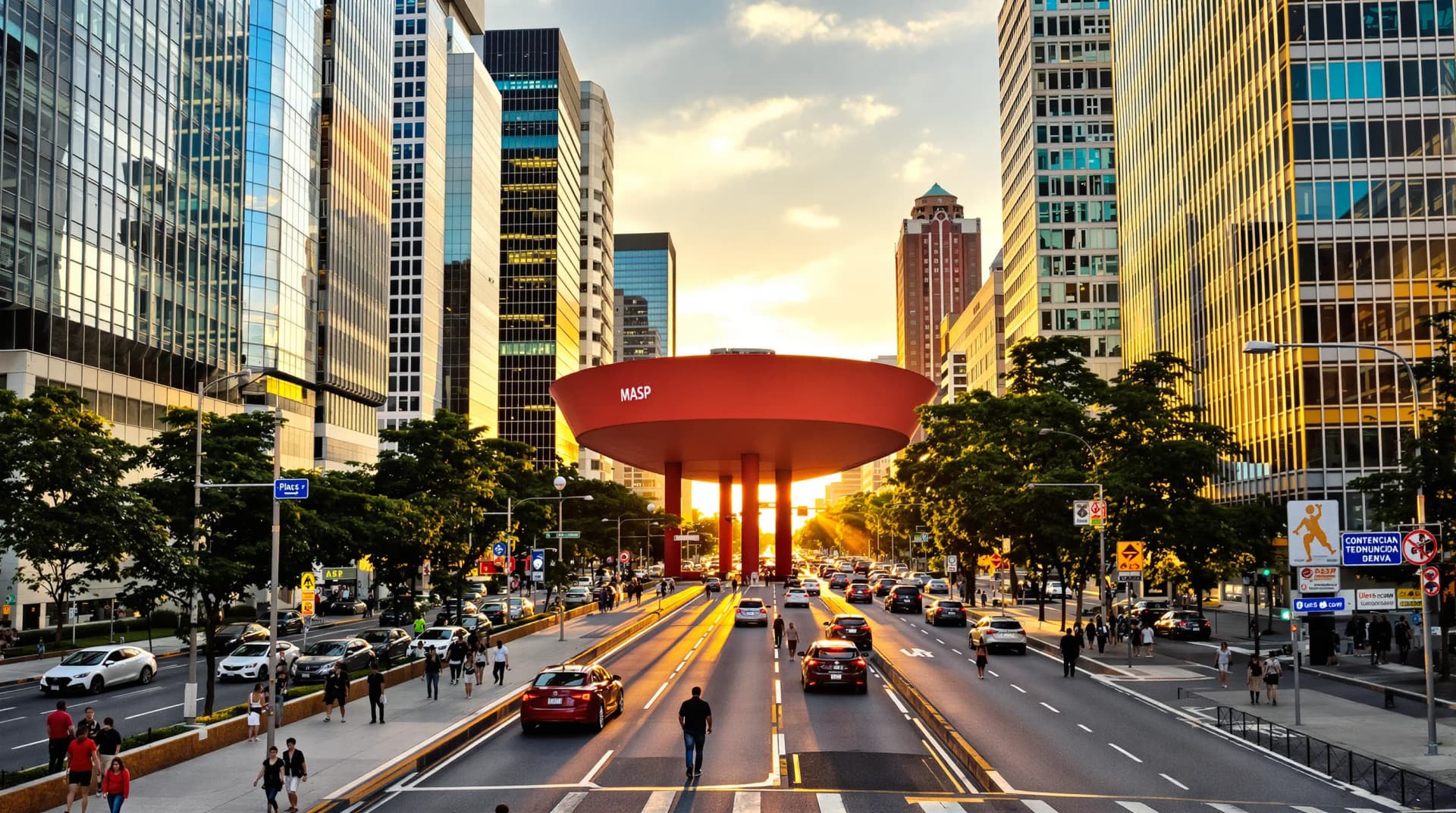
Is São Paulo safe for tourists in 2026?
Traveling to São Paulo?
Talk to a São Paulo security specialist and get a personalized protection plan tailored to your itinerary, risk profile, and travel dates.
Why This Guide Exists
São Paulo's Jan-Apr 2026 quadrimester was its safest on record since 2001: state robberies fell 18.0% to 48,550 (the lowest Jan-Apr total ever recorded), and homicides fell 3.7% to 807. That builds on 2025, which was already a 25-year robbery low (down 16.7% year-over-year) [SSP-SP/Agência SP, 2026; Rio Times, 2025]. Phone theft still accounts for roughly 87% of all robberies in the city, even after falling nearly 50% over four years [SSP-SP/Statista, 2025-2026]. Most travel advisories treat Brazil as a single risk zone: the U.S. State Department issues a blanket Level 2 ("Exercise increased caution") for the entire country. That advisory covers everything from Amazonian river towns to São Paulo's Michelin-starred restaurants on Rua Oscar Freire. The problem is that this approach obscures a critical fact: São Paulo is dramatically safer than its national reputation suggests, and the safety difference between individual neighborhoods within the city is just as dramatic as the gap between São Paulo and the rest of Brazil. This guide exists to close that information gap with verified data, neighborhood-level intelligence, and actionable recommendations focused on the premium executive corridors you are most likely to use.
São Paulo Safety by the Numbers — What the Data Actually Shows
Before making any travel decision, you deserve hard numbers rather than vague reassurances. São Paulo's safety profile is more nuanced — and more encouraging — than most visitors expect. Updated July 2026 with SSP-SP's Q1 2026 release and the latest Numbeo data.
Jan-Apr 2026 Update — Lowest Crime Levels Since 2001
SSP-SP's Jan-Apr 2026 quadrimester release (published late May 2026, via Agência SP/Agência Brasil) is the strongest read yet: state homicides fell 3.7% to 807 (vs. 838) and robbery-homicides fell 39.2% to 31, both the lowest since 2001. Overall robberies fell 18.0% to 48,550, the lowest January-April total ever recorded, and for the first time in a four-month period the state recorded zero bank robberies. The capital's numbers moved the same direction: 161 homicides (-9.55%) and 30,378 overall robberies (-13.6%), what the city secretariat itself called "the lowest criminal indices in the city's recorded history" for the period. Cell-phone robbery is down roughly 50% over four years (from about 54,300 in 2022 to 27,400 in 2026), though it still accounts for roughly 87% of all robberies: still the #1 practical risk for visitors, just a shrinking one. For you as a visitor, the practical read is the same but stronger: São Paulo's risk is managed, declining, and heavily segmented by neighborhood, and the framework below shows you where.
One Counter-Trend, for Honest Reporting
Not every indicator moved the same direction in Q1 2026. Femicides rose 41% year-over-year (86 victims), and protective-order violations and physical assault against women also increased [SSP-SP, Q1 2026]. This is not a tourist-movement risk indicator, but we include it because a safety guide that only cites favorable numbers isn't a trustworthy one.
Homicide Rate in Context
São Paulo state's homicide rate is the lowest in Brazil by either of the two methodologies commonly cited: 5.7 per 100,000 under Sinesp/Ministry of Justice figures, or approximately 6.6 per 100,000 under the Atlas da Violência 2026 (Ipea + Fórum Brasileiro de Segurança Pública) methodology, versus a 20.1 national average either way [Sinesp/Ministry of Justice, 2025; Atlas da Violência 2026, via G1]. Either figure is lower than many American cities and comparable to several Western European nations. The state recorded 2,630 total homicides in 2024, a 3.8% decline from the prior year [Sinesp, 2024].
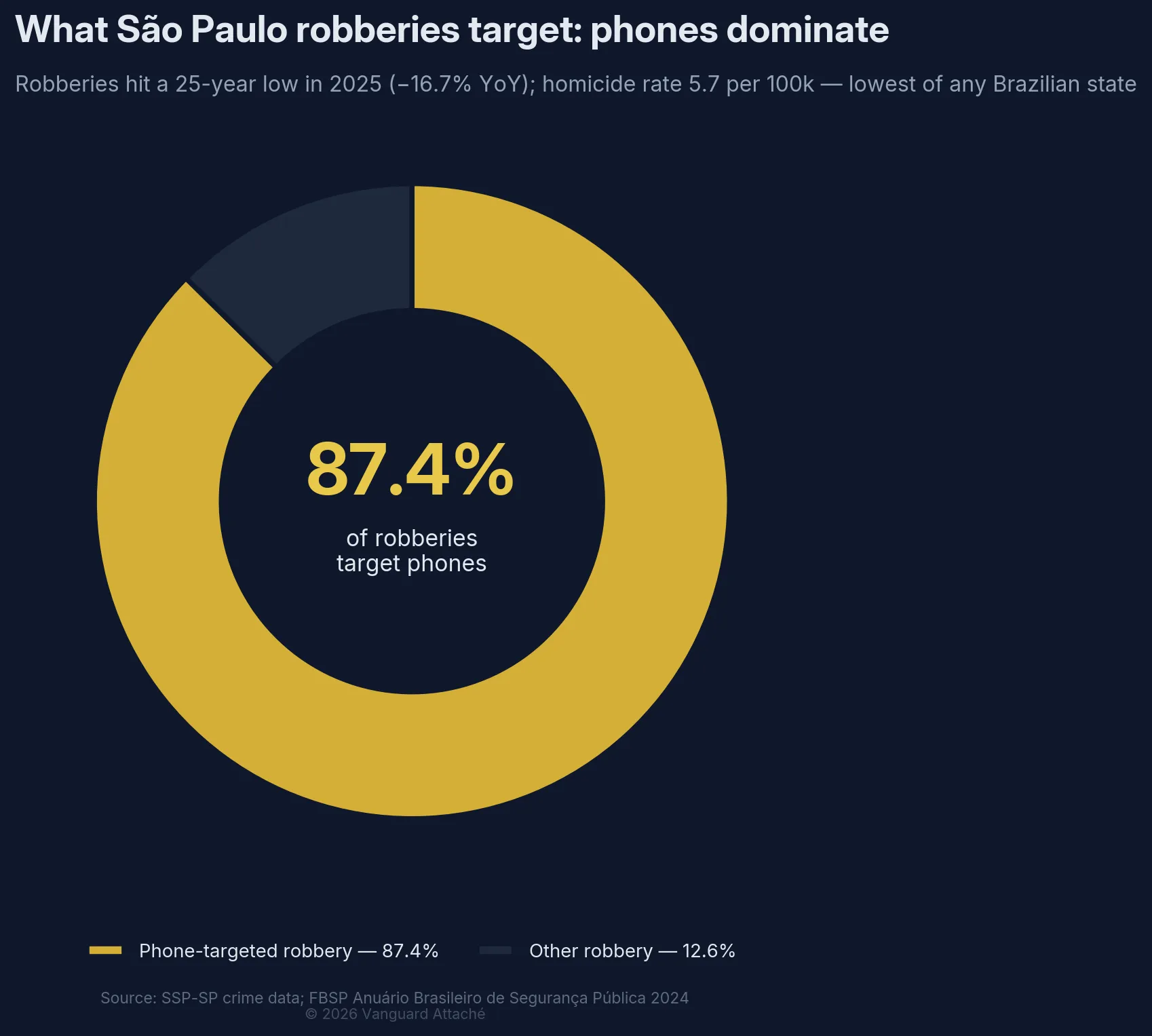
The city achieved its lowest robbery rate in 25 years in 2025, with robberies down 16.7% compared to the previous year [SSP-SP/Rio Times, 2025], a trend that then deepened further in the Jan-Apr 2026 quadrimester above. Cell phone theft accounts for roughly 87% of all robberies in the city [SSP-SP/Statista, 2025-2026], making it overwhelmingly the primary crime risk for visitors, even as its raw volume keeps falling.
Nationally, Brazil recorded its safest year since 2012, with homicide rates declining 22% since 2020 [Sinesp, 2025]. São Paulo has been leading this improvement for years, with its rate now roughly three times lower than the national average.
São Paulo consistently maintains Brazil's lowest homicide rate — 3x below the national average. Source: FBSP, SSP-SP
The Property Crime Picture
Violent crime statistics tell only half the story. São Paulo's Numbeo Crime Index stands at approximately 83.21 (rated "very high"), with safety perception scores of 46.72 for daytime walking and 15.48 for nighttime [Numbeo, 2026]. However, Numbeo scores are perception-based survey data aggregating the entire metropolitan area of 22 million people — including peripheral zones that tourists never visit.
For travelers staying in established neighborhoods (Jardins, Itaim Bibi, Pinheiros, Vila Madalena), the practical property crime risk centers almost entirely on one category: smartphone theft. With 87.4% of robberies targeting mobile phones [Statista, 2025], the risk is highly predictable and solvable: keep your phone in your pocket, step into shops to check maps, and use Uber rather than walking with your phone out. We address specific prevention strategies in detail below.
How São Paulo Compares to Rio de Janeiro
Many visitors traveling to Brazil will visit both cities, so the comparison matters. The contrast is significant:
| Metric | São Paulo | Rio | Brazil Avg |
|---|---|---|---|
| Homicide rate (per 100k) | 5.7 | ~17.1 | 17.1 |
| Primary tourist crime | Smartphone theft | Beach robbery, smartphone theft | Varies |
| Crime pattern | Concentrated in transit corridors, Centro | Dispersed across tourist zones | Varies |
| PIX kidnapping risk | Present | Present | Varies |
São Paulo lacks Rio's beach-proximity crime patterns, and its crime tends to concentrate in specific corridors rather than dispersing across tourist areas. Both cities share the PIX express kidnapping risk and smartphone theft concerns, but São Paulo's overall violent crime profile is substantially lower.
São Paulo records 5.7 homicides per 100K — Brazil's safest state, 7x safer than Bahia. Source: FBSP 2024
Want this data applied to your itinerary?
A Vanguard Attaché specialist turns the numbers into a São Paulo trip plan.
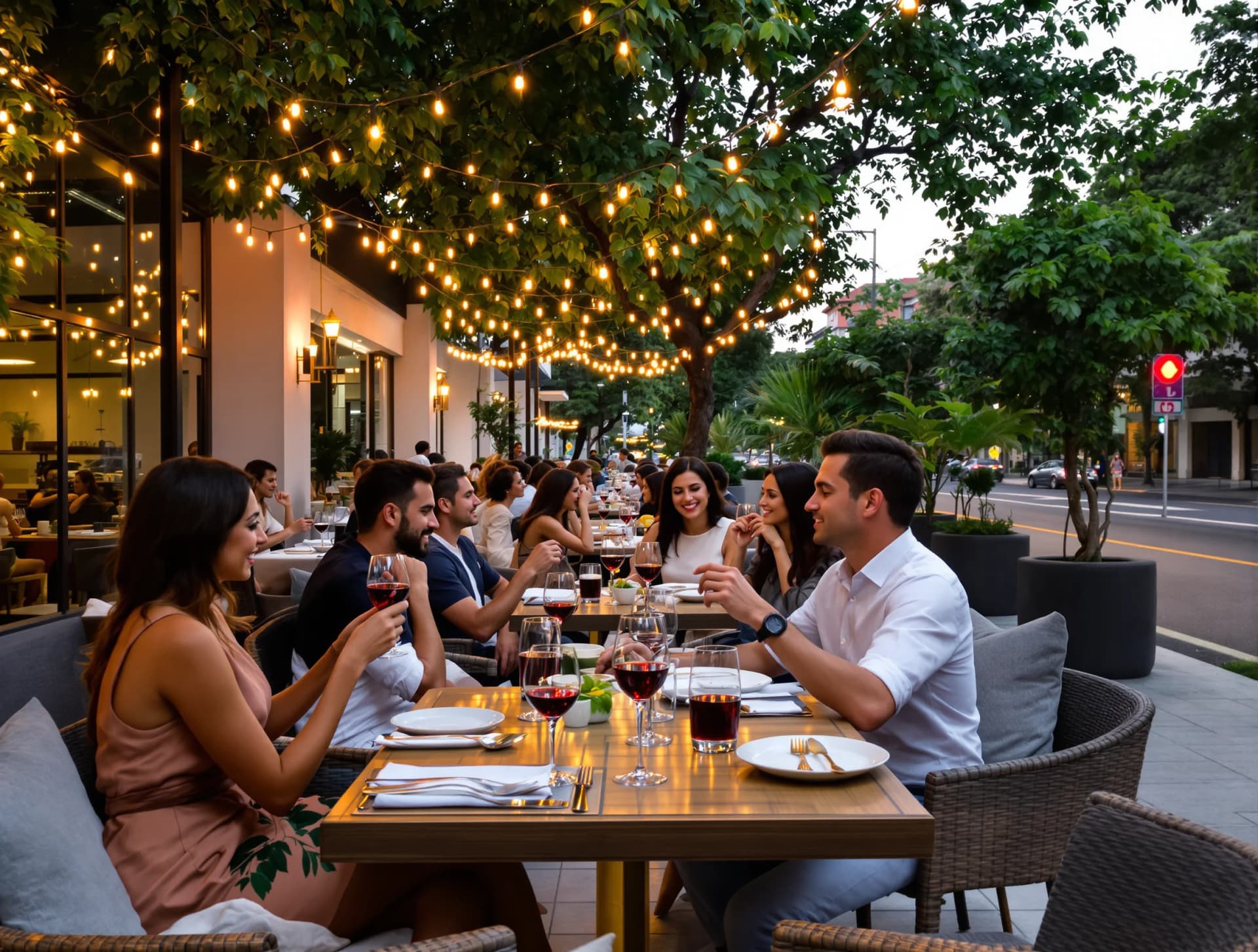
The Jardins neighborhood — São Paulo's safest and most sophisticated destination for visitors
Neighborhood Safety Tiers — Where to Stay and Where to Avoid
The single most important safety decision you will make in São Paulo is where you choose to stay and spend your time. The safety gap between neighborhoods is dramatic — and no government advisory makes this distinction. Below is a four-tier framework based on verified crime data, local intelligence, and on-the-ground experience from our São Paulo operations team.
Security assessment of São Paulo's 96 districts — green zones (Tier 1) concentrate executive hotels and tourist areas. Sources: SSP-SP, PM-SP
These neighborhoods are comparable to upscale districts in major European cities for personal safety. Well-patrolled, well-lit, and well-serviced.
Jardins
Jardim Paulista, Jardim America, Jardim Europa
São Paulo's most prestigious residential area and the top recommendation for luxury travelers. Tree-lined streets, established luxury hotels including the Fasano, Tivoli Mofarrej, and Emiliano, plus Michelin-starred dining along Rua Oscar Freire. Street crime is low relative to the São Paulo average. Excellent metro access via Consolacao and Trianon-MASP stations. This is where most high-end visitors base themselves, and for good reason.
Itaim Bibi
An upscale commercial and residential district with a thriving dining scene. The presence of corporate offices along Faria Lima means heavy private security infrastructure that benefits all visitors. Streets are well-lit and safe for evening restaurant visits. Walking between venues after dinner is reasonable with standard awareness.
Moema
A quiet, residential neighborhood adjacent to Ibirapuera Park. Excellent restaurants, Shopping Ibirapuera, and very low tourist-targeted crime. Metro access via Moema station on Line 5. An ideal choice for families or travelers who prefer a calmer base.
Vila Nova Conceição
One of São Paulo's wealthiest neighborhoods, adjacent to Ibirapuera Park. Extremely low crime by São Paulo standards. Limited nightlife but excellent for daytime activities and park access.
Safe during the day and well-suited for exploration, with minor adjustments recommended after dark.
Pinheiros
Trendy, excellent food and bar scene. Safe during the day; use ride-hail apps rather than walking after midnight. The Faria Lima corridor that borders Pinheiros is well-patrolled.
Vila Madalena
Bohemian character, famous street art around Beco do Batman, and lively nightlife. Safe during the day for cultural exploration. Exercise standard caution with valuables during nighttime bar-hopping, as pickpocketing is known to occur around popular nightlife spots.
Paulista and Consolação
Avenida Paulista is São Paulo's main boulevard, home to MASP, Japan House, and Sesc Paulista. Heavy foot traffic and visible police presence during the day. The Saturday pedestrian closure is popular, safe, and family-friendly. After dark, stick to well-lit main streets and use ride-hail services for longer distances.
Higienópolis
A traditional upper-middle-class residential area near Mackenzie University. Quiet streets, excellent bakeries and cafes, and low crime. A solid alternative to Jardins at a lower price point.
Bela Vista (Bixiga)
São Paulo's historic Italian quarter with good restaurants and proximity to Teatro Municipal. Lower-priced than Jardins, with a different risk profile. Exercise moderate caution on side streets at night.
These areas contain cultural attractions worth visiting during daylight hours but require deliberate security awareness.
Centro (Sé, República, Luz)
São Paulo's historic downtown is home to the Pinacoteca, Mercado Municipal, and Sala São Paulo. These cultural landmarks are worth visiting. However, the area has significant homelessness, drug activity concentrated near Praça Princesa Isabel, and elevated street crime. Visit during daylight hours, travel by taxi or ride-hail rather than walking between attractions, and maintain awareness of your surroundings.
Liberdade
São Paulo's Asian cultural district. The main commercial street is busy and reasonably safe during the day, but the neighborhood borders Centro. Evening restaurant visits are fine; avoid wandering unfamiliar side streets at night.
Brás and Bom Retiro
Wholesale shopping districts. Extremely crowded during business hours, which creates prime conditions for pickpocketing. Not recommended for luxury travelers.
These areas have no tourist infrastructure and present risks that standard precautions cannot adequately address.
Favela communities (Paraisópolis, Heliópolis)
These are residential communities, not tourist destinations. Entry requires local knowledge and relationships.
Peripheral zones (far east and south zones)
Limited infrastructure, higher crime rates, and no tourist interest.
Cracolândia area (near Luz station)
An active open-air drug market. Avoid entirely, even during daylight.
If your itinerary requires travel through or near Tier 4 areas — for example, transit to Guarulhos Airport via certain highway routes — secure transportation with a knowledgeable driver eliminates virtually all risk. Learn about armored transport
Ready to Secure Your Brazil Trip?
Complete our security assessment to receive a custom protection plan built around your itinerary, your destinations, your risk profile and your travel dates.
The Biggest Security Risks for Tourists in São Paulo
Understanding the specific threats you face — rather than vague "be careful" advice — allows you to take targeted precautions. Here are the primary risks, ranked by likelihood for visitors staying in Tier 1 and Tier 2 neighborhoods.
Smartphone Theft — The Number One Threat (Q2 2026 Modality Update)
The vast majority of robbery incidents in São Paulo target mobile phones [SSP-SP, 2024]. Criminals operate on foot, bicycles, and motorcycles, typically snatching devices from distracted pedestrians. The phone is the target, not you. Q2 2026 modality shift: a fatal motociata incident on Marginal Pinheiros on May 9, 2026 marked a tactical change — 2-up motorcycle phone-theft pairs are now operating on the artery itself, not only on the parallel side-streets (Rua Alves Guimarães, Rua Cristiano Viana) where the established pattern still requires pre-20:30 BRT discipline. The Pinheiros central serial-incident cluster (early-evening, multiple victims same vector) reinforces the same window. For passengers in pre-arranged vehicles the practical exposure remains low; for anyone using ride-hail or walking with phone visible along the Marginal corridor after dusk, the risk envelope has widened.
Use your phone discreetly. Avoid extended use while walking on busy sidewalks. When navigating, use earbuds for audio directions rather than holding your phone visible. Consider carrying a secondary inexpensive phone for street use and keeping your primary device secured. On the Marginal Pinheiros corridor after 20:30 BRT, keep phones out of sight in any moving vehicle with windows open or in stopped traffic; the Q2 2026 motociata pattern targets visible devices at the curb-side window.
Express Kidnapping and PIX Scams
Express kidnappings using PIX — Brazil's instant payment system — have increased approximately 30% over five years, according to multiple Brazilian police and media reports [Brazilian media/police reports, 2024]. In a typical scenario, a victim is detained briefly — minutes to a few hours — and forced to transfer money via the PIX app on their smartphone.
This crime predominantly targets individuals who appear affluent and are alone in transitional areas (between safe and unsafe neighborhoods) during late hours. Tourists in Tier 1 neighborhoods using professional transportation are at extremely low risk.
Limit PIX-linked account balances or set nightly transfer caps through your banking app. Avoid walking alone in Tier 3 areas after dark. Use pre-arranged transport rather than hailing vehicles on the street.
Pickpocketing and Petty Crime
Crowded venues — metro stations during rush hour, street markets, popular tourist sites in Centro — create conditions for pickpocketing. This is standard for any major global city and is managed with the same basic awareness you would exercise in London, New York, or Paris.
Use a front-pocket wallet or money belt. Keep bags zipped and in front of you in crowded spaces. Distribute valuables across pockets rather than keeping everything in one place.
Transportation Safety Comparison
Not all transport options carry equal risk. Here is how they compare for visitors in São Paulo:
| Mode | Safety |
|---|---|
| Pre-arranged security driver | Highest |
| Ride-hail apps (Uber, 99) | High |
| São Paulo Metro | High (daytime) |
| Licensed taxi (white) | Moderate |
| Walking | Varies by area |
For business travelers and luxury visitors, a pre-arranged driver with local knowledge remains the safest and most efficient option — particularly for airport transfers, where the routes between Guarulhos (GRU) and central São Paulo pass through mixed-security zones. Our airport transfer service addresses exactly this corridor. Q2 2026 driver-briefing item: Av. Paulista has shown a Wednesday-afternoon arterial-closure signature on the Consolação direction at MASP — most reliably from roughly 14:00 to 22:00 BRT (Wed May 13 full closure confirmed at ~18:10 BRT for a teachers' march toward Consolação). Av. 9 de Julho and Av. 23 de Maio remain the cleared bypasses on Wednesday afternoons. This is a logistics item — not a crime item — but the closure pattern alone can add 25–45 minutes to any cross-town transfer if it is not pre-cleared into the route plan.
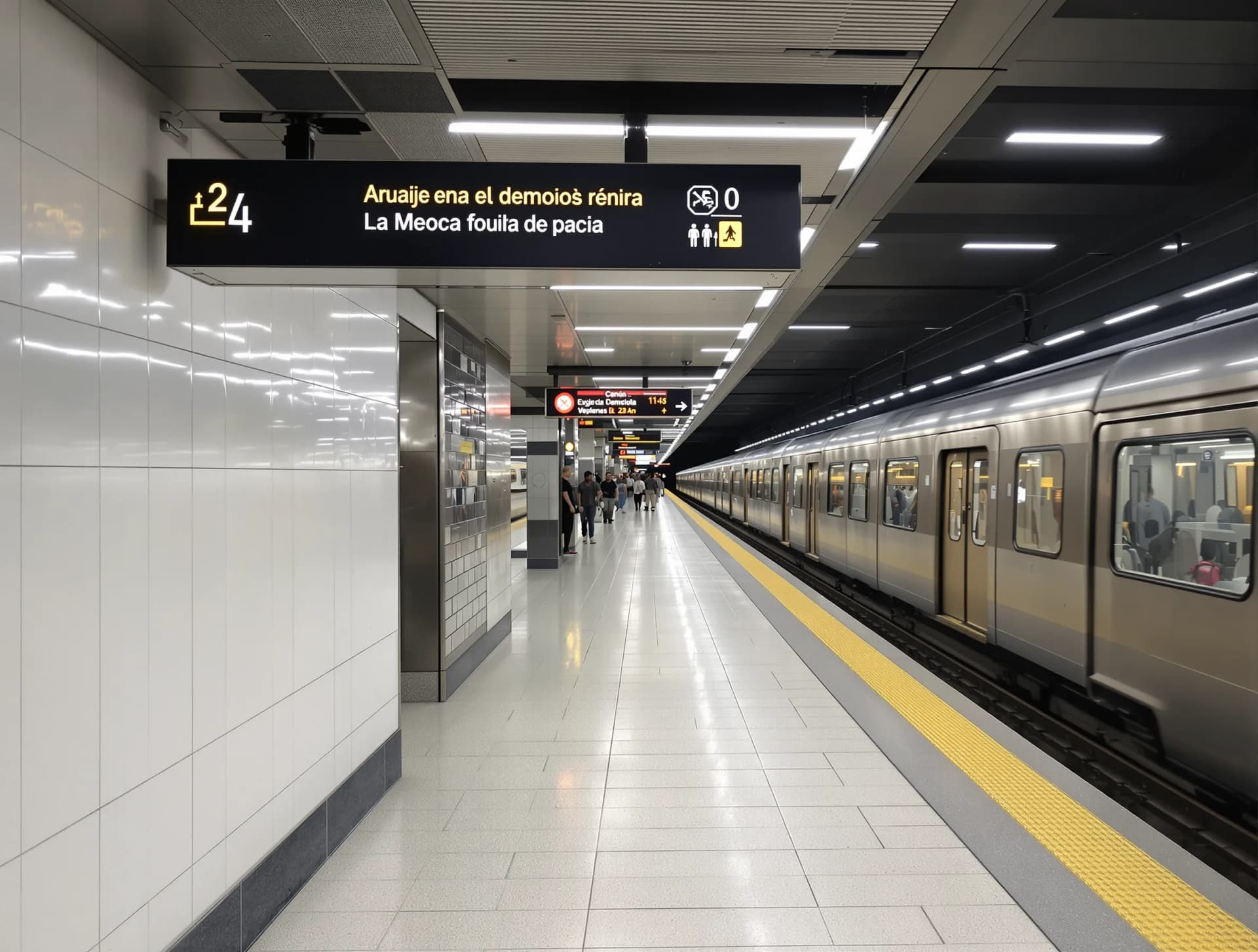
São Paulo's metro system — modern, clean, and safe during operating hours
Seasonal Risk Calendar — When to Visit São Paulo
Crime patterns in São Paulo shift with the calendar. Understanding these cycles helps you time your visit and calibrate your precautions.
São Paulo maintains the lowest risk level year-round — best period: June through August. Sources: SSP-SP, ISP-RJ
Carnival Season (February - March)
São Paulo's Carnival has grown significantly. The city deployed 58,000 security personnel and 40,000 surveillance cameras for 2026 [SSP-SP, 2026]. Street parties (blocos) create large, dense crowds that elevate pickpocketing and phone theft risk. If visiting during Carnival, enjoy blocos in Pinheiros and Vila Madalena (safer concentrations), minimize visible valuables, and use ride-hail for all post-event transport. See our Carnival security guide for detailed regional coverage.
Formula 1 Grand Prix (November)
The Brazilian Grand Prix at Interlagos draws over 290,000 attendees across the race weekend [Perplexity Deep Research, 2024]. The event concentrates in the Interlagos area (southern São Paulo), and corporate hospitality drives significant private security spending. General safety is high within the event perimeter. The primary risk is traffic gridlock on event days, which creates vulnerability in vehicles stuck in slow-moving corridors. Pre-plan routes and timing around the race schedule.
Year-End Holidays (December - January)
Elevated residential burglary rates coincide with vacation departures. For tourists, the main impact is slightly reduced police presence and a shift in street demographics as the city empties of commuters. Tourist areas remain populated and reasonably safe. The Réveillon (New Year's) period brings large gatherings to Avenida Paulista — standard crowd-event precautions apply.
Best Months for Safety-Conscious Travelers
April through May and August through October offer the best combination of lower crime activity, pleasant weather, and fewer crowd-driven risks. Tourism volumes are moderate, which means less street-level targeting of visitors. Cultural events like São Paulo Fashion Week (April and October) concentrate in Tier 1 neighborhoods and carry minimal incremental security risk. Winter months (June through August) also see fewer street crime incidents, as shorter daylight hours and cooler weather reduce both pedestrian activity and opportunistic crime. Q2 2026 standing-item to pre-clear with your driver: a renewed Metrô SP work-stoppage is signaled for Monday May 25, 2026, and the Av. Paulista Wednesday-afternoon arterial-closure signature (Consolação direction at MASP, ~14:00–22:00 BRT) has been the consistent civil-mobilization pattern through May — Av. 9 de Julho and Av. 23 de Maio are the cleared bypasses. This is institutional civic activity, not a crime deterioration; the macro story remains the 25-year robbery low. On the positive side of the same ledger, the PCSP Corregedoria's Jardim Ângela arrests (May 13–14) demonstrate functional internal-accountability capacity, and PMERJ FICCO Phase II operations on the SP side (May 12) ran without major-arterial closures — both signals that SP's institutional response remains intact.
Practical Safety Recommendations for São Paulo
Before You Go
Choose your neighborhood deliberately. Book accommodations in Tier 1 or Tier 2 areas. This single decision reduces your exposure to the majority of tourist-targeted crime.
Set up PIX transfer limits. If you plan to use Brazil's PIX payment system, configure daily and nightly transfer caps through your banking app to limit exposure to express kidnapping scenarios.
Register with your embassy. Enroll in the U.S. Smart Traveler Enrollment Program (STEP) or equivalent for your country. This ensures you receive localized security alerts.
Arrange airport transfers in advance. The corridor between Guarulhos Airport and central São Paulo passes through variable-security zones. Pre-arranged secure transport eliminates the highest-risk transit window of your trip.
Research your itinerary against the neighborhood tiers in this guide to understand which precautions apply at each stop.
Daily Security Habits
Keep your smartphone out of sight when walking, especially on busy streets.
Use ride-hail apps (Uber, 99) rather than street-hailed taxis after dark.
Distribute valuables — do not carry all cash, cards, and phone in one pocket or bag.
Stay on well-lit, populated streets. In Tier 2 neighborhoods after dark, prefer main avenues over side streets.
Learn basic Portuguese phrases for emergencies: "Preciso de ajuda" (I need help), "Ligue para a polícia" (Call the police), "Onde fica a delegacia?" (Where is the police station?).
What to Do If Something Goes Wrong
- •Theft: Do not resist. Comply, then report to the nearest delegacia (police station). For tourists, the DEATUR (Tourist Police Station) in Centro handles English-language reports.
- •Medical emergency: Dial 192 (SAMU ambulance) or go to Hospital Albert Einstein (Morumbi) or Hospital Sírio-Libanês (Bela Vista) — both are internationally recognized facilities with English-speaking staff.
- •Embassy assistance: The U.S. Consulate in São Paulo is located in the Itaim Bibi district. Contact +55 11 3250-5000 for emergencies.
When Professional Security Makes Sense
Most visitors to São Paulo do not need a personal security detail. If you are staying in Tier 1 neighborhoods, using pre-arranged transport, and following the daily habits above, your risk profile is manageable with personal awareness alone.
- High-profile visibility (media, events, recognizable identity)
- Nighttime itineraries that cross into Tier 3 areas
- Multi-city travel including higher-risk regions outside São Paulo
- Travel with family members, especially children
- Business activities that require moving equipment or valuables
Arthur Harris, Vanguard Attaché's founder and a São Paulo native with law enforcement experience spanning LAPD and the U.S. Army Criminal Investigation Division, frames the distinction clearly: the gap between perception and reality is São Paulo's defining security characteristic. The city's reputation overshoots its actual risk for prepared visitors — but the margin shrinks quickly when preparation is absent. A data-driven approach to neighborhood selection, transport, and timing is the most effective security investment any traveler can make.
Explore our protection servicesFrequently Asked Questions
Common questions about São Paulo safety for tourists
Is São Paulo safe for tourists in 2026?
Yes, São Paulo is generally safe for tourists who choose the right neighborhoods and exercise standard urban awareness. The state has Brazil's lowest homicide rate at 5.7 per 100,000 — three times below the national average [Sinesp, 2024]. The primary risk for visitors is opportunistic smartphone theft, not violent crime. Staying in Tier 1 neighborhoods like Jardins, Itaim Bibi, or Moema and using ride-hail transport significantly reduces your exposure to common tourist-targeted incidents.
What are the safest neighborhoods in São Paulo for tourists?
The safest neighborhoods for tourists are in our Tier 1 category: Jardins (including Jardim Paulista, Jardim America, and Jardim Europa), Itaim Bibi, Moema, and Vila Nova Conceição. These areas feature well-patrolled streets, luxury hotel infrastructure, Michelin-caliber dining, and low street crime relative to the broader city. Jardins is the most popular choice for international visitors and offers the best combination of safety, walkability, and access to cultural attractions via the Consolação and Trianon-MASP metro stations.
What areas should I avoid in São Paulo?
Avoid the Cracolândia area near Luz station entirely — it is an active open-air drug market. Favela communities such as Paraisópolis and Heliópolis are residential areas without tourist infrastructure and should not be visited without a local guide. Peripheral zones in the far east and south have higher crime and no tourist attractions. Centro is worth a daytime visit for its museums and Mercado Municipal, but exercise heightened caution after dark.
Is São Paulo safe at night?
It depends on the neighborhood. In Tier 1 areas like Jardins and Itaim Bibi, walking between restaurants and hotels at night is generally safe with standard awareness. In Tier 2 areas like Pinheiros and Vila Madalena, nightlife is vibrant, but use ride-hail apps rather than walking long distances after midnight. Tier 3 areas like Centro and Liberdade should be avoided on foot after dark; use Uber or 99 for point-to-point movement instead.
What time of day is safest to walk in São Paulo?
Daytime is the safest window for walking in São Paulo's Tier 1 and Tier 2 neighborhoods — roughly 7 AM to dusk — when streets are busy and police presence is visible. Risk rises after dark, especially after 8:30 PM, when motorcycle-borne phone-theft pairs are active along corridors like Marginal Pinheiros. Walk freely in Jardins, Itaim Bibi, and Vila Madalena by day, then switch to Uber or 99 after dark.
Is São Paulo safer than Rio de Janeiro?
By the most reliable measure — homicide rate — São Paulo is significantly safer. São Paulo state records 5.7 homicides per 100,000, versus roughly 17.1 for Rio de Janeiro [Sinesp, 2024]. São Paulo also lacks Rio's beach-proximity crime patterns, with incidents concentrated in specific corridors rather than spread across tourist zones. Both cities share smartphone theft and PIX express-kidnapping risks. See our Rio security guide for a detailed comparison.
What are the biggest dangers for tourists in São Paulo?
The biggest danger by frequency is smartphone theft — most robbery incidents target mobile devices. Second is express kidnapping using PIX, Brazil's instant payment system, which has risen about 30% over five years [Brazilian media/police reports, 2024]. Third is pickpocketing in crowded areas like metro stations, street markets, and Centro. Violent crime against tourists in Tier 1 and Tier 2 neighborhoods is rare — your risk is shaped mainly by where you go and how visible your valuables are.
Is Uber safe in São Paulo?
Yes, Uber and the Brazilian app 99 are widely used and considered safe in São Paulo, and are the preferred transport option for locals and visitors alike, particularly after dark. To maximize safety, verify the driver's name and plate before entering, share trip details with a contact, and select private rides over ride-shares. Ride-hail apps beat street-hailed taxis because the trip is logged and the route is tracked.
Is the São Paulo metro safe?
The São Paulo metro is modern, clean, and generally safe during operating hours, and an efficient way to move between major areas by day. Exercise caution during rush hours (roughly 7-9 AM and 5-7 PM), when crowded cars create conditions for pickpocketing — keep bags in front and phones secured. Avoid the metro late at night when stations are less populated; for airport travel, pre-arranged transport is recommended for luggage and routing.
What is express kidnapping in São Paulo?
Express kidnapping — sequestro relâmpago — involves criminals detaining a victim briefly and forcing them to transfer money via PIX, Brazil's instant payment system. PIX-based express kidnappings have risen about 30% over five years [Brazilian media/police reports, 2024]. Criminals typically target people who appear affluent and are alone in transitional zones between safe and unsafe neighborhoods late at night. Prevention includes setting daily PIX transfer limits and using pre-arranged transport after dark.
Is São Paulo safe for solo female travelers?
São Paulo is accessible for solo female travelers, particularly in Tier 1 and Tier 2 neighborhoods. Standard precautions apply: use ride-hail apps rather than walking alone late at night, stay in well-populated areas, and keep your phone and valuables secure. Areas like Jardins, Pinheiros, and Vila Madalena have active, diverse street life that makes solo exploration comfortable by day and early evening. Many solo travelers report positive experiences when they choose neighborhoods and transport deliberately.
When is the safest time to visit São Paulo?
The safest months are April-May and August-October — between Carnival season and the year-end holidays. Tourist volumes are moderate, crowd-driven crime events are fewer, and the weather is pleasant. Winter months (June-August) also see reduced street crime due to shorter daylight and cooler temperatures. Carnival (February/March) and the F1 Grand Prix (November) draw large crowds that raise pickpocketing risk but are manageable with preparation. The year-end holidays see slightly reduced police presence.
Do I need a bodyguard in São Paulo?
Most tourists do not need personal security in São Paulo. If you stay in Tier 1 or Tier 2 neighborhoods, use pre-arranged transport, and follow this guide's recommendations, your risk profile is manageable with personal awareness alone. Professional executive protection becomes valuable for high-profile individuals, travelers with complex multi-city itineraries, or families visiting mixed-tier areas. The real question is less "do I need a bodyguard" and more whether your specific itinerary benefits from professional security planning.
Take this guide with you
The neighborhood tiers, the transport decisions, and the phone protocol from this page, distilled to a one-page checklist you can keep on your phone and forward to your travel group. No sign-up — the PDF is yours.
Get the São Paulo checklist (PDF)Also traveling to Rio?
Sources cited
- SSP-SP — Estatísticas de Segurança Pública de São Paulo (monthly state-level crime data)
- Fórum Brasileiro de Segurança Pública — Anuário Brasileiro de Segurança Pública
- U.S. Department of State — Brazil Travel Advisory
- UK FCDO — Brazil Foreign Travel Advice
- OSAC (Overseas Security Advisory Council) — Brazil reports
- CDC — Brazil Traveler Health information
Ready to Secure Your Brazil Trip?
Complete our security assessment to receive a custom protection plan built around your itinerary, your destinations, your risk profile and your travel dates.
The Bottom Line on São Paulo Safety in 2026
São Paulo is statistically the safest major state in Brazil, with homicide rates declining year over year and now standing at 5.7 per 100,000 — three times below the national average [Sinesp/Ministry of Justice, 2024].
Neighborhood selection is your most powerful safety tool. The difference between Jardins and Centro at night is as dramatic as the difference between São Paulo and Brazil's most challenged states. Choose Tier 1 or Tier 2 accommodations and plan your itinerary around the framework in this guide.
The primary threat is preventable. Smartphone theft accounts for the majority of tourist-targeted incidents. Basic phone awareness and ride-hail transport address the most common risk.
Timing matters. April through May and August through October offer the best security profiles for travel planning. Carnival and F1 season require additional preparation but remain safely accessible.
São Paulo rewards visitors who approach it with intelligence rather than anxiety. This is a city of 22 million people with Michelin-recognized dining, significant architecture, culture, and business depth — and the security data to support confident travel when you know where to go and how to move.
If your trip to São Paulo would benefit from professional security planning — whether for airport transfers, event attendance, multi-day itinerary support, or discreet executive protection — Vanguard Attaché provides complimentary initial security assessments tailored to your specific travel profile.
Security conditions can vary by date and location. Recommendations herein are provided for informational purposes only and do not constitute a guarantee of safety. Statistics cited reflect the most recent verified data as of May 2026. Contact Vanguard Attaché for a tailored risk assessment.
Related Reading
Is Brazil Safe for Tourists in 2026?
A country-wide safety breakdown for visitors to Brazil, drawing on FBSP 2024 crime data and official travel advisories, to help you see how regional risk varies before you plan your itinerary.
InsightsIs Rio de Janeiro Safe for Tourists in 2026?
A neighborhood-by-neighborhood breakdown of Rio de Janeiro's safest districts, including Ipanema, Leblon, and Copacabana, built on ISP-RJ 2026 crime data and the same tiered framework used in this São Paulo guide.
For YouFor Family Offices
Planning a principal's or UHNW family's Brazil trip? The directing-operator model.
LibraryView All Insights
23 Brazil security intelligence articles.
Continue planning your trip
Use these related guides to understand your options and prepare your next questions.