Key Insight
Brazil's private security sector is federally regulated under Law 14,967/2024, and all armed protection must be performed by Polícia Federal-authorized providers. The buyer's job is not to become the investigator who extracts a licence number — it is to engage a single accountable principal who owns the planning and command, assures that licensed-under-command execution, and stands behind the whole operation. Professional teams can deploy on a timeline they will confirm in writing when clients arrive prepared.
If you've searched "bodyguard in Brazil," you've already noticed the problem: the results are a mix of tourism operators, overseas brokers who have never set foot in São Paulo, and service pages that tell you almost nothing useful. Hiring professional security in Brazil is not complicated — but it requires knowing what to look for and what to avoid.
This guide consolidates two earlier articles into a single definitive resource. By the time you finish reading, you will know exactly how to assess your risk, verify credentials, understand costs, and book professional security in Brazil.
- How to honestly assess whether your trip warrants professional security
- The difference between an unarmed escort, armed agent, and full executive protection team
- Why a single accountable principal — not a documents scavenger hunt — is the credential that matters most
- The 8-question vetting framework used by professional security buyers
- What to decide before the first call — and why a fast deployment is achievable
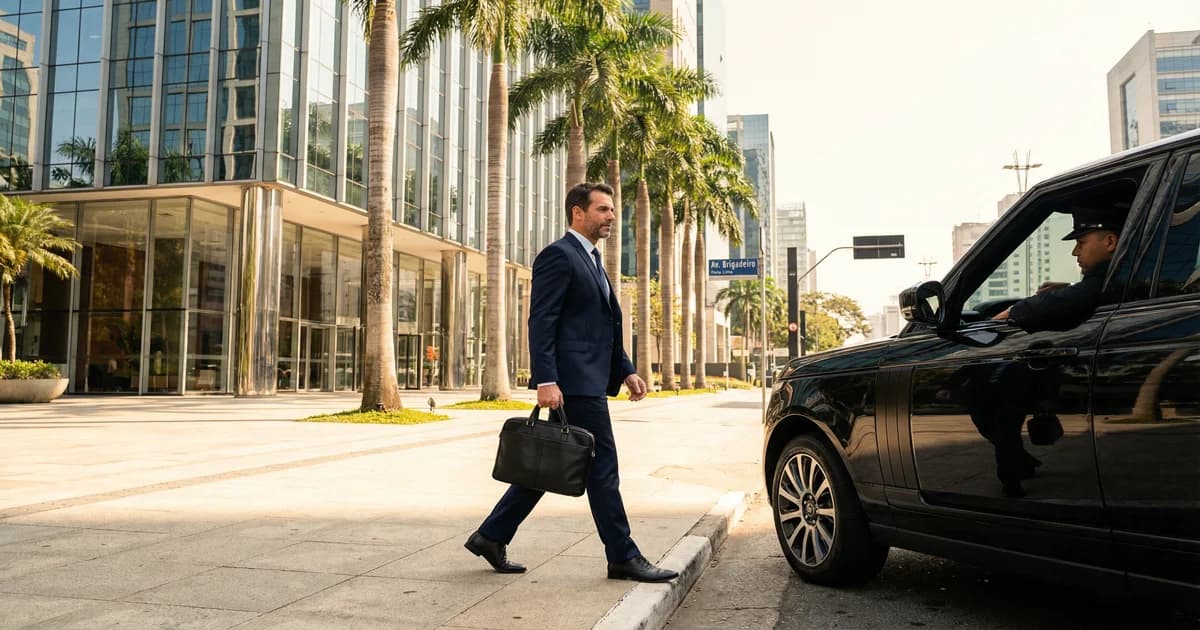
One reframe before the six steps. The instinct when you search "how to hire a bodyguard" is to shop for muscle — a fit person who stands next to you. That is the wrong unit of analysis for Brazil. What an executive actually needs here is access without exposure: getting into the Faria Lima meeting, the Jardins dinner, and the off-map venue, and back out, on schedule, without becoming the easiest target in the room. The right hire is rarely a lone bodyguard; it is a vetted driver who knows the Congonhas-to-Faria-Lima window, a pre-cleared route, an advance contact who already knows the door, and a protective presence calibrated to the room rather than the street. That is the difference between hiring a guard and retaining an access operator with a security spine — and it is the lens to carry through the credential checks, cost tiers, and vetting questions below. The recurring São Paulo threat the plan is built around is specific and dated. On the night of 17 May 2026, on Rua do Símbolo in Vila Andrade — an affluent, Morumbi-adjacent residential pocket — two men on a beige Yamaha Ténéré robbed an off-duty police officer and his brother of their phones outside a condominium. The officer handed his phone over and lived; his brother, Leandro Fernandes de Souza, 40, resisted and was shot dead. That is the whole modality in one case — a two-up motorcycle, an affluent corridor, an evening return home, and resistance as the one thing that turns a stolen phone into a fatality — and it was the second such killing in the south zone in that May 2026 series. It is why our default is zero-resistance, with the protective presence concentrated on the few exposed seconds at the condominium or hotel door, not on heroics at the curb.
Step 1: Should You Hire Security? The Honest Risk Assessment
Before you look at any provider, spend fifteen minutes on an honest self-assessment. Hiring security when you don't need it wastes money and creates friction on your trip. Not hiring it when you do creates exposure that no precaution will fully offset.
Is your name searchable on LinkedIn or business media? Criminal intelligence increasingly uses OSINT to identify high-value targets before they land.
Are you traveling with high-value watches, jewelry, or equipment? The express kidnapping economy in Brazil targets these signals specifically.
Will you be moving between neighborhoods or holding meetings in locations you haven't personally vetted?
Have you publicly associated yourself with cryptocurrency assets? Crypto-linked kidnappings have increased significantly.
Are you relying on rideshare apps for late-night transit? Transit corridors between secure zones are the highest-risk windows.
Intelligence-gathering through romantic apps is a documented targeting method for HNW visitors. This appears in police reports.
Step 2: What You're Actually Buying
Acompanhante (Unarmed Escort)
An unarmed individual providing basic presence, route assistance, and low-level deterrence. Not subject to the full VSPP regulatory framework. Appropriate for low-risk itineraries where the primary value is local navigation.
VSPP (Vigilante de Segurança Pessoal Privada)
The legally defined category for personal protection professionals in Brazil. VSPP certification requires a 200-hour base vigilante course plus a 40–60 hour personal security extension [Polícia Federal, 2024]. This is the minimum credential threshold for professional personal protection.
Full Executive Protection Team
Two or more VSPP agents operating under an integrated operational model — including an advance agent, close protection agent, armored vehicle transport, and operations center coordination. For multi-day engagements or high-profile public appearances.
Step 3: How to Find Providers (And Who to Avoid)
Red Flags — Disqualify Immediately
- ✗No accountable principal — no single party who owns the planning and command and stands behind the whole operation when something fails between vendors
- ✗Cannot assure that armed protection runs through Polícia Federal-authorized providers, with a single accountable party answerable for it — a legal requirement under Law 14,967/2024
- ✗Pricing far below the market for a legitimate armed agent — the math doesn't work once you account for licensing, insurance, and vetted personnel
- ✗A pure introducer who hands you off and exits — no command layer, no intelligence, no advance work, no concierge, just a markup for connecting you to whoever actually does the work
- ✗"4-hour deployment" guarantees without qualification — not a real standard
- ✗Cannot tell you what it would decline to do — a serious operator names the requests it refuses, such as armed work it cannot run through a Polícia Federal-authorized provider, before you have to ask
Ready to Secure Your Brazil Trip?
Complete our security assessment to receive a custom protection plan built around your itinerary, your destinations, your risk profile and your travel dates.
Step 4: The Vetting Framework — 8 Questions That Separate Real Operators From the Rest

Who is the single accountable principal for my engagement — and will you stand behind the whole operation, including the armed component?
This is the question that matters most. Under Law 14,967/2024, all armed protection in Brazil must be performed by Polícia Federal-authorized providers. You should not have to become the investigator who hunts down a licence number; the right answer is a provider who takes ownership of the entire operation and assures you, in writing, that the regulated armed component is delivered by PF-authorized providers under its direction. A serious provider stands behind that licensing as an assurance — it does not push the compliance burden back onto you.
Is every deployed agent lawfully employed and PF-licensed under an accountable command that owns the whole operation?
This is the right question — not "do you personally employ every guard?" The directing-operator model that leading international risk firms use answers it cleanly: a single accountable prime owns the intelligence, planning and command, and the armed agents are lawfully employed and PF-licensed by its authorized local provider, deployed under that prime's command. What you are testing for is unbroken accountability and lawful, credentialed execution — not whether one company happens to hold every licence and employment contract itself.
When will you supply the credentials of the agents deployed on my detail, and who is accountable if something is wrong?
The agents deployed on your detail must hold current Polícia Federal credentials. Expect a reputable coordinating firm to deliver the executing partner's legal name, CNPJ, PF authorization for segurança pessoal and current Certificado de Regularidade at signing — not in a pre-quote email — and a full refund if they are not delivered, or if any document is missing or does not verify on the PF lookup, up to 48 hours before service. The assigned agents' credentials follow before deployment. Expect the disclosed partner to be covered by a non-circumvention clause; ours runs for 12 months. Accountability for credentialed execution should sit with the principal you contract, not with you.
Who is accountable for the vehicles deployed on my detail, and to what ballistic standard?
Level III-A ballistic protection (NBR 15000 Nível IIIA, the legal maximum for civilian armored vehicles in Brazil) is the standard for high-risk urban environments. What matters is not whether one company holds the vehicle title, but whether a single accountable party commands the transport and answers for vehicle condition end to end. Ask for vehicle specifications and maintenance posture, and confirm one party is accountable for them — not a chain of unaccountable rentals.
Have your agents completed VSPP certification? What is the training curriculum beyond the baseline course?
The minimum is a 200-hour base vigilante course plus the VSPP personal security extension. Leading operators invest significantly beyond this baseline. Ask about ongoing training protocols — scenario drilling, emergency medical, counter-surveillance.
Can you provide a written threat assessment for my specific itinerary and dates?
A professional operator will not quote you a price before asking about your schedule, destinations, and known exposure factors. A proposal without a prior threat assessment is a price quote from a commodities vendor, not a security professional.
What is your coordination desk capability?
For multi-day engagements, your security team should be supported by a continuous operations center — a dedicated communications hub that tracks your team's position, monitors local intelligence, and can escalate responses. Ask specifically about this capability. Then ask that desk two follow-ups: how medical emergencies and evacuation are planned for your itinerary, and how response is committed. The answer you want is specific to your dates and places and confirmed in writing for the engagement. Treat a single headline response-time figure, quoted before anyone has seen your itinerary, as a sales number rather than a plan.
If something goes wrong between vendors at 2 a.m., who is the one party accountable to me?
This is the single most revealing question in the vetting process, and it deserves to be asked twice. A pure introducer evaporates the moment there is a problem, because no one owns the seams between the driver, the armed agent and the venue. The answer you want is unambiguous: one accountable principal owns the entire operation — intelligence, planning, command, transport and the PF-authorized armed component delivered under that command — and answers to you for all of it. Unbroken accountability, not a particular ownership or employment structure, is what protects you when the plan meets reality.
Step 5: Understanding Cost
| Service Tier | Cost Range | Includes |
|---|---|---|
| Unarmed Escort | Quoted on request | Basic presence, route assistance, low-level deterrence. No weapons. |
| Armed VSPP Agent | Quoted on request | VSPP-certified agent with Level III-A armored vehicle. Professional protection. |
| Full EP Team | Quoted on request | Multiple agents, advance capability, operational coordination. High-profile. |
| Priced Far Below Market | DISQUALIFIED | The math does not work for a legitimate VSPP agent. Be wary of any quote dramatically below the rest; a legitimate provider supplies PF authorization at signing. If it cannot, walk away. |
Duration and Coverage Hours
Full-day coverage costs more than a dedicated four-hour window. Multi-day retainers typically carry a lower effective daily rate than single-day bookings.
Geographic Complexity
An engagement confined to the Faria Lima corridor is simpler than one spanning three neighborhoods in Rio with event attendance. Complexity requires more advance work and coordination.
Team Size and Capability Stack
A single VSPP agent is significantly less expensive than a two-agent team with separate advance capability. For most leisure travelers, a single armed agent with armored transport is the right balance.
Step 6: What to Have Ready Before You Call
Arthur's Insider Perspective
The Single-Accountable-Command Test
The question is not "do you personally employ every guard?" — in Brazil the armed agents are lawfully employed and PF-licensed by a Federal Police-authorized provider, by law. The question that actually protects you is whether one accountable principal owns the whole operation and commands that licensed execution end to end. On a Vanguard Attaché engagement, we direct the intelligence, planning, command, transport and concierge, and the regulated armed component is delivered under our direction by our PF-authorized partner. That partner's PF documents are delivered at signing, with a full refund if they are not delivered or don't verify, up to 48 hours before service, and the disclosed partner is covered by a non-circumvention clause. One party stands behind all of it. That is the standard every operator should be held to — and the one many cannot meet.
Local Knowledge Over Brand Recognition
International security brands carry global reputations built on work in other markets. In Brazil, that reputation does not translate to local threat intelligence, police relationships, or cultural fluency. A team with five years of São Paulo operations will outperform a team flown in from London, every time.
Written Threat Assessment Before Any Proposal
A security quote without a preceding threat assessment is meaningless. Arthur's standard practice — inherited from criminal investigation work where no conclusion is reached without analysis of the facts — is to understand the threat picture before recommending a service tier. Clients who receive a price before a threat assessment have received a sales pitch, not security advice.
The Question to Always Ask
"Who is the one party accountable to me for the entire operation — including the licensed armed component?" A lone licensed guard firm is a component, not a substitute: it is state-limited, with no independent intelligence, advance, GSOC or command layer, no concierge, and no one to answer for the seams between vendors. The provider that owns the whole operation, and stands behind the PF-authorized execution under its direction, is the one that protects you when something goes wrong.
Brazil, Secured and Simplified
Related Resources
Frequently Asked Questions
How much does a bodyguard cost in Brazil per day?
Bodyguard costs in Brazil scale across three tiers: a basic unarmed escort or security driver, an armed VSPP-certified agent with Level III-A armored vehicle, and a full executive protection team with multiple agents, advance capability, and an operations center. Ask each provider for a written day-rate quote — a quote far below market cannot legally, safely, or operationally deliver professional protection under Brazil's regulatory framework.
Do I need a bodyguard for a family vacation in Rio or São Paulo?
Most family visitors to Rio and São Paulo do not require professional security, but the honest answer depends on your specific profile and itinerary. São Paulo's tourist and business districts operate at a measurably low risk level — the state recorded a homicide rate of 5.7 per 100,000 in 2024 [SSP-SP, 2024]. Rio's tourist zones recorded zero homicides in Q1 2026 [ISP-RJ, 2026]. Where families benefit most is in airport-to-hotel transit and high-exposure movements. An armored transfer plus a security driver for key movements is often a practical middle ground that provides meaningful protection without the full overhead of a close protection team.
What's the difference between a bodyguard and executive protection in Brazil?
The distinction reflects a fundamental difference in operational philosophy. A bodyguard is a reactive presence: they respond to a threat once it materializes. Executive protection is a proactive system: it identifies and prevents threats before they reach the principal. In Brazil's regulatory framework, both fall under the VSPP certification category, but executive protection adds the operational layer of threat assessment, advance work, route analysis, and ongoing counter-surveillance. The relevant question is whether you want reactive presence or proactive management of your security environment.
How far in advance do I need to book security in Brazil?
A professional team can deploy on a timeline they will confirm in writing — but only when you walk in knowing your itinerary, risk level, preferred team size, and budget. Lead time is not about paperwork or logistics; it is about how much advance work you want completed before your team is in the field. If you confirm your travel two to three weeks out, that window enables full threat assessments, venue pre-surveys, hotel security coordination, and detailed route analysis. Book as soon as your travel is confirmed.
Can I hire protection in Brazil without speaking Portuguese?
Yes. Any operator worth engaging provides bilingual agents — fluent in both English and Portuguese — as a baseline standard. This is not a premium add-on. In a fast-moving situation, real-time communication in your language is not optional. When evaluating providers, specifically confirm that assigned agents are operationally fluent in English, not merely conversational.
Can I hire a bodyguard for just one day in Brazil?
Yes, single-day engagements are a standard service offering in São Paulo and Rio de Janeiro. The service delivery is identical to multi-day engagements: threat assessment, agent assignment, vehicle confirmation, and operational coordination for your specific itinerary. Single-day engagements are well-suited to specific high-exposure moments — a business meeting in an unfamiliar area, attendance at a large public event, or a high-value transaction.
Sources cited
- Polícia Federal do Brasil — private security company authorization framework (VSPP / segurança privada)
- Planalto — Lei 10.826/2003 (Statute of Disarmament; firearms licensing in Brazil)
- SSP-SP — Estatísticas de Segurança Pública de São Paulo
- ISP-RJ — Instituto de Segurança Pública do Rio de Janeiro
- Fórum Brasileiro de Segurança Pública — Anuário Brasileiro de Segurança Pública
- OSAC (Overseas Security Advisory Council) — Brazil threat assessment
- U.S. Department of State — Brazil Travel Advisory
- CNN Brasil — "Irmão de PM morre baleado durante tentativa de assalto na zona Sul de SP" (Vila Andrade, May 18, 2026)
- Metrópoles — "PM é vítima de roubo, irmão reage e é baleado e morto por dupla em SP" (Morumbi/Vila Andrade, May 18, 2026)
Ready to Secure Your Brazil Trip?
Complete our security assessment to receive a custom protection plan built around your itinerary, your destinations, your risk profile and your travel dates.