What this page covers — and why now
Your principal lands at GIG on Sunday, 17 May. That is the fixed point. Argus opens the public agenda Monday, but the Petrobras one-on-ones — the meetings most trader principals are actually flying in for — start that Sunday afternoon, typically 24 to 48 hours ahead of the public schedule.
In the four working days ending 7 May, four named police combat operations pressured every primary corridor between GIG, Zona Sul, and Barra. This is the corridor briefing your driver, your detail, and your travel-planning EA need before that Sunday lands — eight days from today, not two.
If you’re routing a Vitol, Trafigura, Gunvor, Mercuria, or smaller-house principal into Rio for Argus, what follows is everything we’d hand you if you’d already retained us: a dated route hierarchy, a morning confirmation protocol your team can run, what to do if your driver gets into a traffic dispute, and what changes if Argus locks in a Barra venue instead of Copacabana.
One note on timing. Argus has not yet confirmed the host hotel in second-source press. The most-likely band is Copacabana–Leblon — we cover the Barra contingency in the last section. And yes, eight days is the right window for this. At 48 hours out, hotel, vehicle, and driver decisions are already locked — this is the phase where there is still time for a route swap or a venue cancel.
The three corridors your driver will navigate
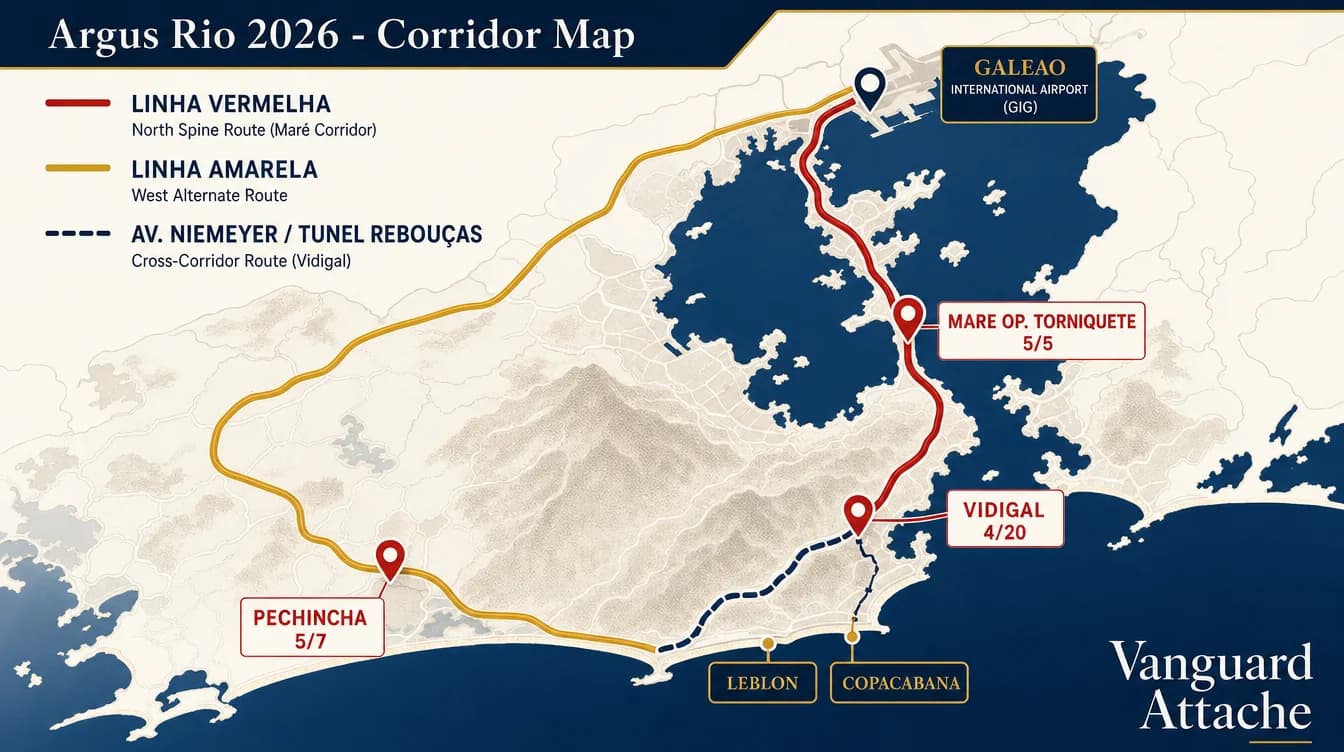
Across a Sunday-arrival, Wednesday-departure profile, three corridors carry the load. Each one below gets a primary route, an alternative, and at least one named disruption event from the past 30 days that anchors why the hierarchy matters this week.
1. GIG → Copacabana / Leblon (arrival corridor, Sunday May 17)
Primary: Linha Vermelha → Av. Brasil → Túnel Rebouças → Lagoa → Copacabana / Leblon.
Alternative: Linha Amarela → Túnel Rebouças → Lagoa → Copacabana / Leblon.
On May 5, Operação Torniquete Phase 2 in Maré closed both lanes of the Linha Vermelha from 11:40 to 13:35 BRT and interdicted Av. Brasil; 41 schools across the Maré complex suspended morning classes. On May 6, Operação Rede Cobre extended the operational footprint to Fallet-Fogueteiro, Niterói, Caxias, Magé and Italva. Program totals through this week record 900+ prisões and over R$52 million in declared recoveries from the Op. Torniquete program totals — meaning the operational tempo on this axis is not winding down; it is in the middle of a sustained territorial reassertion.
For a Sunday afternoon arrival, the Linha Vermelha remains primary — Sundays are statistically the lowest-tempo day for combat operations in Maré. But the Linha Amarela alternative should be pre-cleared every morning of May 18, 19 and 20: a Maré 9 May evening report — still pending corroboration but consistent with the operational tempo above — suggests territorial reassertion through approximately 14 May, abutting the Argus arrival window. Your corridor briefing should be re-confirmed every morning through the 14th.
2. Copacabana / Leblon ↔ Barra-side meetings (cross-corridor, any day)
Primary: Av. Niemeyer (São Conrado–Leblon corridor) for Barra-side moves; Túnel Rebouças → Av. das Américas for moves with an armored detail.
Alternative: Linha Amarela → Av. Ayrton Senna → Av. das Américas (longer; less direct exposure to incidents).
On April 20, Operação Duas Rosas II in Vidigal produced a Comando Vermelho roadblock — a hijacked bus across Av. Niemeyer — during a daylight shootout on Morro Dois Irmãos. Approximately 200 tourists were isolated atop Morro Dois Irmãos for the duration of the shootout. Av. Niemeyer reopened at approximately 07:20. Niemeyer is the primary São Conrado–Leblon corridor. It is the route between any Copacabana / Leblon principal hotel and any Barra-side meeting venue. It is the same arterial that, on April 14, generated a stray-bullet civilian injury near the BRT Minha Praia stop on Av. Salvador Allende during a PM response to a phone-robbery approach. The signature on Barra arterials — phone-robbery initiated, armed-PM-response escalated — is now a dated and repeated operational pattern, not an outlier.
For Argus principals on Copacabana/Leblon ↔ Barra moves, Niemeyer is the primary route only in clear-weather, daylight, off-peak windows confirmed against the 22º BPM daily disposition. Outside that window, the Túnel Rebouças → Av. das Américas alternative is correct. The longer Linha Amarela bypass becomes primary on any morning when Vidigal or Rocinha registers a Fogo Cruzado event in the prior 12 hours — a daily check we run for principals routed across this seam.
3. Petrobras one-on-one stops in Centro (Sunday May 17 / Monday May 18 morning, early arrivals)
Primary: Lagoa → Aterro do Flamengo → Centro (south-to-north along the bay). It is the Zona Sul → Centro spine.
Alternative: Av. Brasil southbound from Linha Vermelha exit. The week-of-May-7 disruption profile makes this alternative unreliable across 18–20 May.
Av. Brasil came under interdiction pressure during Op. Torniquete Phase 2 (5/5) and within the operational footprint of Op. Rede Cobre (5/6). The Aterro do Flamengo route is unaffected by the Maré operational halo and is the correct primary for any Centro one-on-one routed from a Copacabana–Leblon hotel during the conference week.
The two-touch corridor pre-confirm protocol
This is the morning routine we run for principals during a a busy Rio week with multiple operations pressuring corridors — every morning, before the vehicle starts. The framing is ours and worth showing. And if you’re routing a principal into Rio without an EP detail, your team can replicate the first touch on its own — the second touch is the harder one.
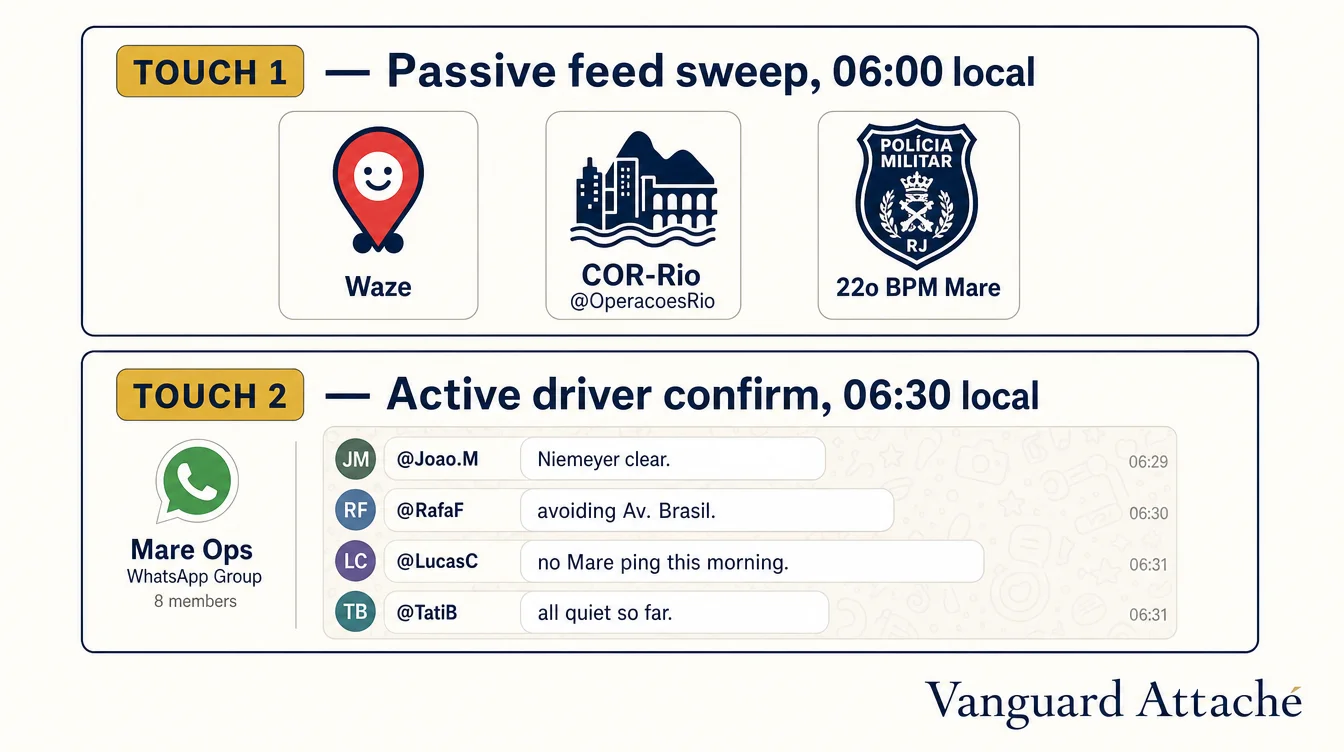
Touch one — passive-feed sweep, 06:00–06:30 local
Three feeds, in order, scanned by the lead driver before vehicle warm-up:
- Waze — set route from hotel to first appointment; review red incident pins along the corridor. Brazil’s Waze population is dense enough that a closure registers within minutes.
- COR-Rio (@OperacoesRio no X) — the city’s Centro de Operações posts traffic, weather and safety advisories with a typical 3–8 minute lag.
- 22º BPM Maré social channel — where reachable; secondary Maré-watcher pages serve as the equivalent. The 22º BPM daily disposition is the closest signal to "is the Linha Vermelha going to close in the next two hours."
Touch two — active confirm, 06:30–07:00 local
Driver-to-driver WhatsApp on a closed group of vetted Rio operators we maintain. Three questions: Which corridors are you running this morning? Which are you avoiding? What did you see in the last 30 minutes? This is the touch that produces decisions. Passive feeds tell you a closure exists. Active confirm tells you whether the closure is the kind you wait out, the kind you reroute around, or the kind you cancel the trip for.
For Argus mornings May 18, 19 and 20, the two-touch protocol runs against the 06:00–11:00 departure window, repeated for any afternoon outbound.
Where to stay, where to eat, and what to skip after dark
The most-likely Argus hotel band is Copacabana Palace, Fasano Rio, or a Belmond-tier Leblon property. The operational implications:
- Hotel-floor protocol. Same-floor or adjacent-floor accommodation for the close-protection element, with a vetted housekeeping schedule for the principal’s room. Standard for any Rio stay of this kind; non-negotiable during a week with this disruption density.
- Vehicle pre-position. Armored SUV with discreet detail — not a visible motorcade. Pre-positioned at the hotel for the duration of stay, May 17–22. Argus principals are repeat Brazil visitors; the demand profile is unambiguous on this point. A visible motorcade is the wrong instrument here.
- Dining inside the perimeter. Pre-cleared dining for evening programming should sit inside the Copacabana–Ipanema–Leblon band: Oro, Fasano Al Mare, Lasai, Copa Café, the Palace’s Hotel Fasano rooftop. Each pre-cleared by an advance walk: lobby exits logged, kitchen-side egress confirmed, parking pre-position confirmed. Don’t accept a venue your detail hasn’t pre-walked — the walkthrough should cover those three points at minimum.
- What to skip. Skip Lapa and Centro evening venues during Argus week. Centro empties out after 7 PM — the exposure profile is not justified for a 72-hour trip.
Two things changed about how your detail should move in Rio this week
Two incidents this past week update — not introduce, update — what we now teach drivers and detail leads. Both apply to your Argus team.
If your driver gets into a traffic dispute, the rule has changed
On Thursday May 7, Thamires Peixoto, age 28, was shot in the back of an Uber on the Pechincha/Taquara stretch of Jacarepaguá by an off-duty 29ª DP officer, Frede Uilson Souza de Jesus, in what is currently being investigated as a road-rage escalation. The incident occurred approximately 6.5 km from the Cidade das Artes / Rio2C operational area — the same Jacarepaguá operational halo that Argus delegates would traverse for any Barra-side moves.
The protocol update: on traffic-friction events, the principal vehicle yields. Always. Even when the other vehicle is wrong.
The Pechincha case is the anchor. A civilian, fatally shot in the back, in a vehicle, by an off-duty Civil Police officer, after a traffic-friction interaction. The old baseline — that off-duty armed agents in Rio default to a normal civilian conflict-resolution envelope — is, at minimum, locally falsified. Your driver’s instruction set during Argus week: yield, document, do not engage, do not pursue, do not escalate by horn, gesture, or pace. Your team is not negotiating right-of-way during a 72-hour trip. We call this the passive-yield rule — it is the discipline we now teach every Brazilian principal driver in our network. Your team should have a written version of it before wheels-down.
Phones in transit: where they go and what to do if one gets taken
Phone-robbery is the originating event in two Rio incidents in the last 30 days that escalated to civilian gunfire injury (the April 14 BRT Minha Praia stray-bullet case is the cleanest example). The protocol is two-part.
Physical (during transit). Principal phones stay below window-line, off-lap, not in hand. No hand-out-the-window photography on Av. Niemeyer, Av. Brasil or Av. das Américas. The cost of a missed Instagram shot of Cristo from the car is zero. The cost of a phone-robbery approach against a stationary armored vehicle in traffic is non-zero and asymmetric.
Post-incident (the 72-hour playbook). If a phone is taken — and only if the principal has fully complied with the physical posture above so we are not re-litigating that decision — your 72-hour post-incident playbook runs in this order: BO filed at the nearest Delegacia within 24h, banking and email tokens rotated within 4h, replacement device pre-staged at the hotel within 12h, conference badge re-issued by the Argus secretariat. We have run this exact 72-hour playbook for four trader-class principal visits across SP and RJ since late 2024. The framework exists because the incident class exists — your team should have a written version of its own.
What changes if your principal ends up in Barra
If Argus’s host-hotel announcement (whenever it lands) confirms a Barra venue rather than a Copacabana / Leblon property, the briefing changes in three places.
- One. Arrival corridor inverts. GIG → Barra is no longer Linha Vermelha primary; it is Linha Amarela → Av. Ayrton Senna → Av. das Américas primary, with the Linha Vermelha → Túnel Rebouças routing as a longer alternative. The Maré disruption profile becomes less direct but does not disappear — the Linha Amarela still passes the Maré complex on its eastern flank.
- Two. The Barra-side seam becomes the host corridor. Av. das Américas km 15–17 is the conference-hotel band for Barra venues; Estrada da Curicica and Av. Engenheiro Souza Filho are the secondary feeders into the Cidade das Artes / Olympic Park area. The April 14 BRT Minha Praia incident plots directly onto this seam. The Pechincha case is 6.5 km from Cidade das Artes. The contingency briefing becomes a Barra-arterial briefing rather than a Zona-Sul-to-Barra-bridge briefing.
- Three. Hotel pre-clear shifts to Grand Hyatt Barra, Hilton Barra, Windsor Marapendi class. The dining perimeter shifts to BarraShopping district and the Av. Lúcio Costa beach band rather than the Copacabana–Leblon band. Don’t extend evening programming back into Zona Sul on a Barra-host conference — the cross-bay nighttime exposure isn’t justified for a 72-hour trip. Same logic as the Zona Sul setup: cross-corridor evening programming is the exposure to skip.
The two-touch corridor pre-confirm protocol does not change. That’s the point of having a protocol.
For principals traveling Argus + extension
For delegations bundling the Argus window with a post-conference leisure extension, read our Rio brief on the 500-tiroteio milestone and cross-bay logistics before locking the plan. The two pieces are designed to be read together by teams doing the trip in a single Rio pass. → Read the Rio cross-bay brief (prior week)
Request the daily corridor-confirm shortlist
If you’re routing a principal to the Argus Rio Crude Conference May 18–20 — or to any of the Petrobras pre-meetings on the 17th — message our 24/7 desk for the live corridor-confirm shortlist updated each morning of the conference window. We’ll send the day’s primary, the day’s alternative, and the day’s specific avoid list. No commitment, no cost — the brief is the value, and you already have it.