1. The four-event window
Between Monday 28 April and Thursday 7 May 2026, four off-duty police lethal-force events occurred across São Paulo and Rio de Janeiro. They are not one story. They are four stories that share one structural feature, and a different one that the press coverage is collapsing.
We treat them in chronological order, with the names and the case files where the public record supports them.
- Mon 28 April — Butantã, São Paulo. A contested off-duty PM shootout. A businessman and a suspect both dead. Polícia Civil and PM Corregedoria are running a dual investigation. The widow contests the official "shootout" framing. This is the precedent event for the cluster — the analytic thread starts here. Dedicated case analysis →
- Tue 5 May ~20:30 — Morumbi, São Paulo. Rua Gabriel de Amorim, roughly four kilometres from the Berrini / Vila Olímpia / Itaim corridor. An off-duty officer of the 16º BPM/M was targeted for armed robbery on a stolen motorcycle by a single suspect with prior ring-thefts record. The officer reacted with lethal force. The suspect died at the scene. A revolver and the stolen motorcycle were apprehended. The case sits at the 89º DP as morte decorrente de intervenção policial. The Morumbi event is the control case. The official narrative is uncontested. The modality matches the persistent two-up motociata ring-thieves pattern in Morumbi residential adjacency. There is no civilian fatality. There is no widow disputing the version. The officer is — on the public record as it stands today — a legitimate-defence actor who did the job correctly.
- Wed 6 May ~21:00 — Rua Alba, Jabaquara, São Paulo. Roughly five kilometres from Vila Olímpia / Berrini, three kilometres from Morumbi. An off-duty PM on a motorcycle entered a traffic dispute with the occupants of a car. Verbal escalation became a physical fight. The officer opened fire, alleging the 25-year-old victim tried to grab a weapon. The victim was transported to Hospital Saboya and did not survive. SSP-SP corroborates the officer's version via witness statements. The case sits at the DHPP as roubo + resistência + morte decorrente de intervenção policial. This is the first civilian fatality in the cluster.
- Thu 7 May ~17:00 — Pechincha / Taquara, Rio de Janeiro. Rua Professor Henrique Costa, the dividing road. An off-duty Civil Police officer — Frede Uilson Souza de Jesus, 29ª DP Madureira, named in the TJRJ judicial record, driving a white Peugeot, fired through the dark rear glass of an Uber following a traffic-merge dispute. The passenger, Thamires Rodrigues de Souza Peixoto, 28, designer de sobrancelhas, was shot in the back and died at the UPA Cidade de Deus. In deposition, Frede admitted he could not see who was inside the vehicle and assumed it was a robbery. He turned himself in on 8 May. The TJRJ 3ª Vara Criminal decreed temporary detention the same day, citing “comportamento agressivo,” “motivo fútil,” and institutional risk. PC-RJ Corregedoria-Geral suspended him. The public record shows six prior anotações criminais between 2007 and 2020, four of them for violência doméstica.
That is the four-event window. Four officers. Three contested cases. One uncontested. Two civilian fatalities. Ten days.
2. The pattern lives in the difference, not the surface
The press coverage so far has been honest, useful, and — for our specific job — wrong about which thread to pull.
The thread the coverage is pulling is *off-duty police violence*. Treated as a single phenomenon. Four events, one story, an indictment of a class of officers operating outside the discipline of duty hours. We understand why that frame appears. It is not unfair. It is not partisan. It collapses on contact with operational reality.
Here is what collapses it. The Morumbi officer did the job correctly. We will say it again because it is the part of this analysis that fails if we mumble: the Morumbi officer did the job correctly. A criminal targeted him for armed robbery. He responded with proportional lethal force. The suspect's record was consistent with the modality. The recovered weapon and stolen motorcycle corroborate the version. There is no civilian fatality and no contested narrative. If we are honest about what we see, the Morumbi case is what a properly-functioning off-duty intervention looks like in a city where serving police are themselves regularly targeted.
If "off-duty police violence" were the right lens, the Morumbi case would belong in the same category as Pechincha. It does not. It is a different category. And the moment you separate it out, the actual operational pattern in the other three becomes visible.
The pattern is traffic friction → escalation → lethal force.
Butantã is a contested shootout in which the surrounding circumstances are still being investigated. Jabaquara is a traffic dispute that became a fight that became a shooting. Pechincha is a traffic-merge dispute that became a Peugeot pulling alongside an Uber and firing through the rear glass. The trigger condition in all three contested events is mundane. Not a robbery in progress. Not an armed confrontation initiated by a suspect. Friction in traffic. The kind of friction that, on any given evening in any residential neighbourhood in either city, occurs hundreds of times without consequence.
What changes in the three contested cases is not the trigger. It is the shooter.
In the Pechincha case, the shooter was — on documentary evidence available before he ever fired a round — a person with six prior criminal annotations, four of them for domestic violence. That is not a generalisation about police. It is a specific fact about a specific individual whose history was on file with the institution that employed him. The TJRJ 3ª Vara Criminal's own language in the temporary-detention decree — comportamento agressivo, motivo fútil — is the court reading that history forward into the act.
The shooter is the variable. The trigger condition is mundane. And the Pechincha shooter was identifiable as elevated-risk before the incident, not after.
This is not an "all police" story. The Morumbi case proves that decisively. It is also not a "police are fine, this was an aberration" story. The Pechincha case proves that decisively. It is a "we cannot, from inside a passing vehicle at five p.m. on a Thursday, tell the difference between a Morumbi-officer and a Pechincha-officer" story. And once that is the operative claim, the protocol that follows is non-negotiable.
3. What this means for the principal vehicle
The principal vehicle never engages traffic friction. Not now, not last week, not after the cluster cools. The standing rule is the standing rule because the trigger is mundane and the variable is unknowable in real time.
The passive-yield rule, in operational terms:
- On any vehicular friction event — a cut-off, a horn dispute, a finger gesture, a brake-check, a tailgater closing aggressively — the principal vehicle yields immediately and reroutes. The yield is not a courtesy. It is a protocol.
- No eye contact. Not in the rear-view, not in the side mirror, not turning the head.
- No return-gesture. Not the hand, not the horn, not a brake-check returned.
- No rolling-down-the-window. The window stays up. The conversation does not happen.
- Do not stop except in a populated, lit setting. A residential side street at 21:00 is neither.
- Never assume an unidentified fast-approach vehicle is a legitimate police signal. Plainclothes, white-plate, civilian sedan, a single occupant gesturing to pull over — none of these is, by itself, a lawful identification. A real police stop in either city has visible markers and a clear lawful signal. If those are absent, the protocol is to continue at safe speed to a populated, lit setting and only then assess whether to stop.
We brief this rule with every driver we work with. We brief it again, in writing, after every event of this kind. We are briefing it again now.
The reason to write it down — and to write it down today, while the Pechincha case is fresh — is that the rule is easier to teach when the example is concrete. Drivers who shrug at "yield to all friction always" do not shrug at "yield to all friction always, because the Peugeot in Pechincha was driven by an officer with four domestic-violence annotations and he could not see who was in the Uber."
The principal does not need to know any of this. The driver does.
4. What this means for Uber and black-car operators
Here is where the Pechincha case widens. Thamires Peixoto was not a principal. She was a passenger in an Uber. The driver was, on the public record, doing his job — moving a passenger through a residential neighbourhood at five p.m. on a Thursday.
The case implicates the driver's decision-making, not the passenger's. And the implication is uncomfortable for the entire black-car layer, including ours.
When a fast-approach plainclothes vehicle pulls alongside in residential traffic with no uniform visible, no marked vehicle, no lawful signal — pulling over is the wrong play. The Uber driver in Pechincha had no way to verify that the Peugeot's occupant was an officer. No one in his position could have. The cue that is available — a single male in a civilian vehicle gesturing aggressively after a merge dispute — is operationally indistinguishable from the cue that precedes a robbery or a road-rage shooting.
This forces a referral protocol implication for our network. We work with Uber and black-car operators in the principal corridor. We brief our drivers on this rule and we are now briefing it more explicitly to the network we refer to:
- A fast-approach plainclothes vehicle in residential traffic, no uniform visible, no marked vehicle — continue.
- A clear marked vehicle with lights, in a public setting, with a lawful signal — yield to the lawful stop in the populated, lit setting.
- If the driver is uncertain whether the approach is lawful — the right answer is to keep moving to a populated setting, not to pull over in residential traffic.
This is not a critique of police. It is a function of the fact that, from inside a moving Uber at 17:00 in Pechincha, the driver cannot run a background check on the white Peugeot behind him. He has to make a binary call on partial information. The Pechincha case settles which way that call should go.
We share the laminated passive-yield card we issue our drivers and the referral-network operators we work with most often. Reply for a copy.
5. What this is not
This kind of analysis fails fast in two predictable directions, so we will name both before they get named for us.
This is not a partisan reading. The framework is not "police bad" and not "police good." Two of the four events are clear-eyed examples of officers operating in roles where that distinction is empirically the wrong question. The Morumbi officer responded correctly to a real armed-robbery attempt. The Pechincha officer killed a civilian in an act the TJRJ has formally characterised as motivo fútil. The framework that puts both in the same political bucket is the framework that prevents you from writing the right protocol.
This is not an "all police" story. We will not say it once and let it sit. We will say it through the analysis, and we will say it again here. The Morumbi case must be acknowledged because if you do not acknowledge it, your operational rule degenerates into "do not interact with police," which is not a rule we can issue and not a rule that survives the first lawful traffic stop. The rule we issue is narrower and survivable: the principal vehicle never engages traffic friction, and the driver assumes nothing about an unmarked, fast-approach vehicle until the lawful signal is unambiguous.
The serving officer who responded correctly in Morumbi is the officer the rule is designed to coexist with. The officer in Pechincha is the officer the rule is designed to survive.
This is not commentary. It is an operational discipline. The reason we write it up at all is that the principal corridor in São Paulo's Zona Sul and Rio's Zona Oeste includes Jabaquara and the Jacarepaguá belt. Both are routine residential transit zones for client movements. The cases happened in places we drive through. They will happen again, somewhere, on a different Thursday.
6. The window forward
Hospitalar 2026 opens at São Paulo Expo on 19 May. The expo's Imigrantes location sits roughly 2.8 kilometres south of the Rua Alba, Jabaquara incident — which means the principal corridor for the event runs through one of the two civilian-fatality sites named in this piece. Rio2C runs 26–31 May at Cidade das Artes in Barra, roughly six and a half kilometres from the Pechincha site. Both events sit on our standing 30-day event-corridor overlay.
We are already briefing the passive-yield rule into the driver and CP-team training cycles for both events. We are also folding the Pechincha case in by name, because — as a pedagogical anchor — it is more durable than abstract protocol. Drivers retain the rule when the rule is paired with a concrete reason it exists.
The rule existed before this week. The reason just got sharper.
7. The four-event dataset
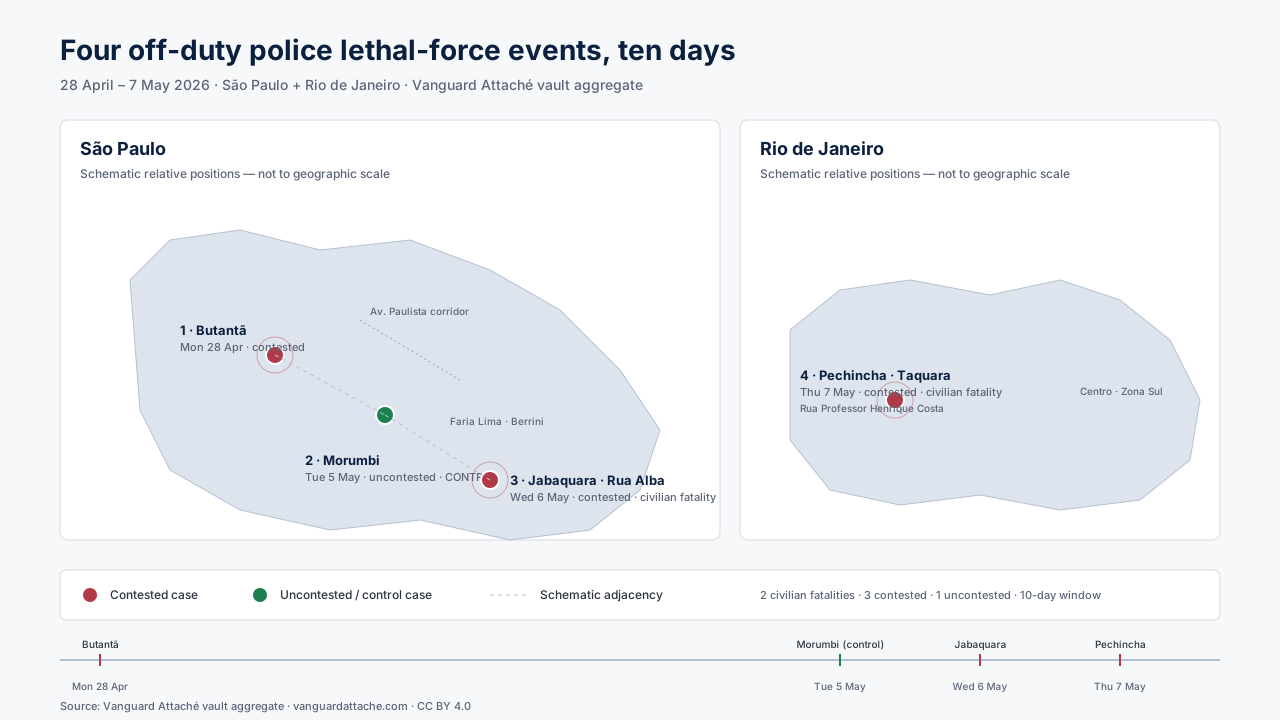
We are publishing the four-event aggregate as a citable dataset rather than leaving it as paragraph references. The schematic map above and the table below are the same data in two forms. Each row is anchored to a vault-side incident file and a public-record event description.
| # | Date | Neighbourhood · City | Status | Trigger condition |
|---|---|---|---|---|
| 1 | 2026-04-28 | Butantã, São Paulo | Contested · civilian fatality | Robbery-encounter (disputed circumstance) |
| 2 | 2026-05-05 | Morumbi (Rua Gabriel de Amorim), São Paulo | Uncontested (control) | Targeted armed robbery on stolen motorcycle (officer was target) |
| 3 | 2026-05-06 | Jabaquara (Rua Alba), São Paulo | Contested · civilian fatality | Traffic friction → physical fight → lethal force |
| 4 | 2026-05-07 | Pechincha / Taquara (Rua Professor Henrique Costa), Rio de Janeiro | Contested · civilian fatality | Traffic-merge friction → fired through Uber rear glass |
Aggregate. Four events. Three contested. One uncontested. Two civilian fatalities. Ten-day window. Two cities. The three contested events share one structural trigger: traffic-friction → escalation → lethal force. The uncontested event (Morumbi) is the analytical control — it does not share that trigger.
A machine-readable copy of these four rows is available at /datasets/off-duty-pm-lethal-cluster-2026-04-28-2026-05-07.json (CC BY 4.0). Journalists, researchers, and security operators who want the raw aggregate can pull it directly.
Brief your driver tomorrow morning
Save this and brief it to your driver tomorrow morning. Then reply to this email and I will send the laminated passive-yield card we use with our drivers and the referral-network operators we work with most often.