If your principal has Rio exposure this quarter, the four operating days of 5–8 May changed the threat model under them — and you may not know it yet. In that window, Rio’s Civil Police ran three major operations against Comando Vermelho and TCP. None of the three were primarily about confrontation. The targets were a shell-company network, a banking-fraud chain, and a copper-receivership operation. The kinetic outcomes — one suspect dead at Maré, Linha Vermelha closed for one hour and fifty-five minutes — are the part the international press wrote about. They are not the part that matters to you.
What changed in your operating environment those four days
Between Monday 5 May and Thursday 8 May 2026, the Polícia Civil do Estado do Rio de Janeiro (PCERJ) executed three discrete major operations against organized-crime infrastructure across three different zones of the city. PMERJ followed on the fourth day with a Cidade de Deus + Gardênia Azul movement that sat in the same operational halo. The four-day cluster is the densest combat-ops package the city has run since the late-April cycle, and the targeting logic across all four events is the part worth slowing down for.
Monday 5 May — Operação Rastreio (PCERJ Cidade Nova 6ª DP, Complexo de São Carlos)
The week opened with a cross-state operation. PCERJ’s Cidade Nova 6ª DP, working a case file built across early 2025, executed warrants at Complexo de São Carlos in central Rio (the Estácio / Cidade Nova / Catumbi adjacency) and — same morning — at multiple addresses on the São Paulo state side. The target was a TCP-affiliated cell running a multi-stage chain: high-value smartphones robbed in central Rio and the Zona Sul, unlocked at São Carlos, personal data exploited downstream for fraudulent bank transfers and loans opened in the victims’ names.
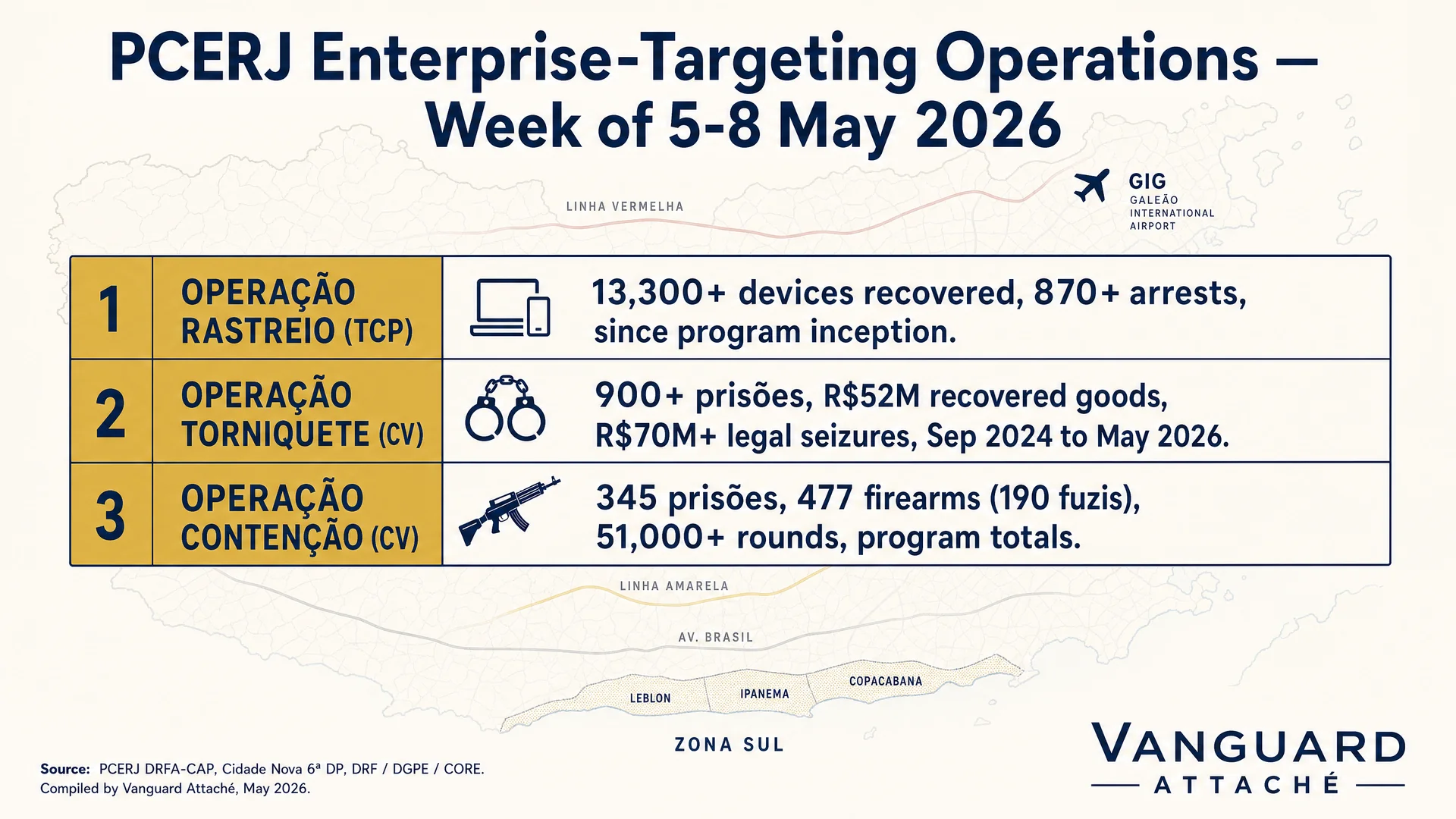
The program totals are the part that should land for any executive-protection brief reader. Since Operação Rastreio’s inception, PCERJ has recovered 13,300+ devices (approximately 6,000 returned to victims) and made 870+ arrests. That is not an opportunistic-theft program. That is an industrial counter-fraud workload, and the cross-state warrant pattern (Rio-led, São Paulo-side execution) is the giveaway: the upstream chain straddles state lines.
The Sunday 3 May Av. Brasil incident — at the end of Shakira-event egress, a single arrest recovered 28 cellphones from one person — sits inside this same monetization chain. A crew of organized mass-event egress thieves working the Sambódromo / Engenhão / Maracanã ring is not a one-off pickpocket; it is a sourcing layer for the unlock-and-fraud operation that PCERJ rolled up on Monday morning.
Tuesday 6 May — Operação Torniquete Phase 2 (PCERJ DRFA-CAP / DRFC, Complexo da Maré)
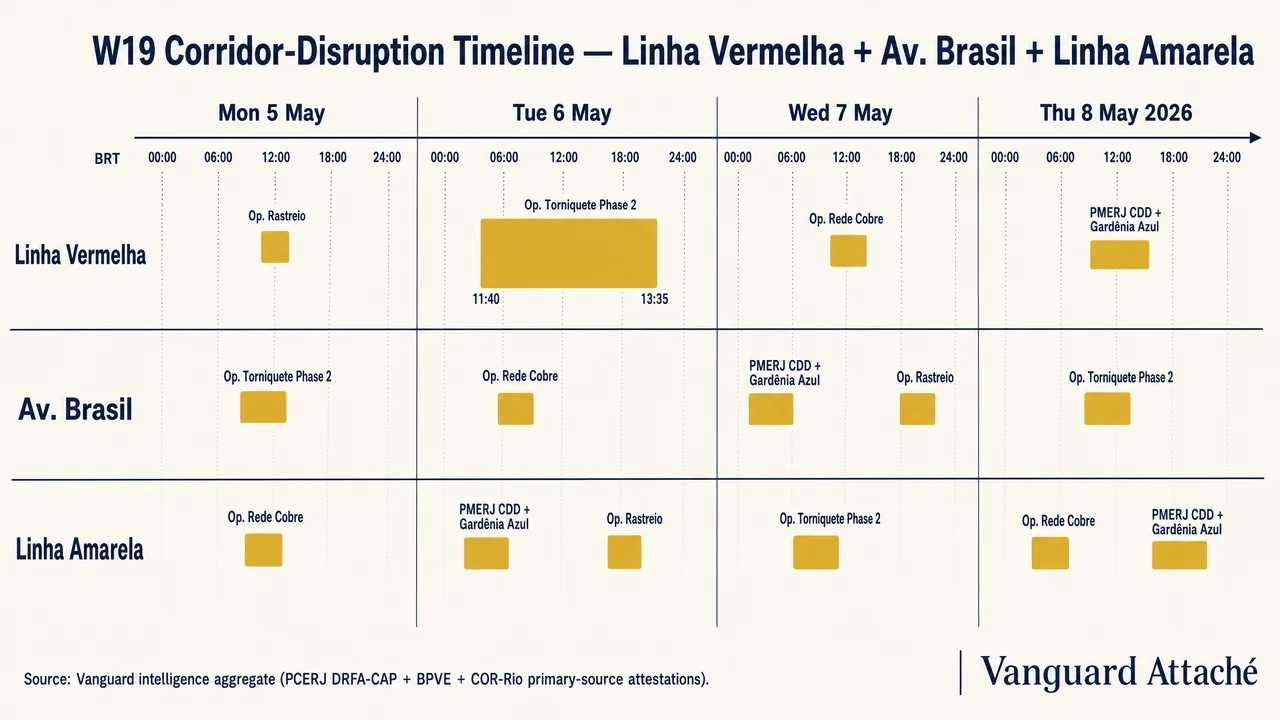
Phase 2 of Torniquete went into Maré (Nova Holanda + Bonsucesso) under DGPE coordination with CORE support. The operational outcome reads cleanly: 1 suspect killed in confronto, 12 prisões, 16 firearms seized (including one fuzil + pistols + revolvers + shotguns), 2 grenades, 43 vehicles, and one captive capuchin monkey rescued. Linha Vermelha closed both lanes from 11:40 to 13:35 BRT. Av. Brasil was interdicted on the same stretch during gunfire intervals. Forty-one municipal schools suspended morning classes; one UPA suspended attendance and two more delayed opening; nine bus lines (321 / 323 / 325 / 327 / 485 / 492 / 635 / 2343 / 2344) lost service.
Now read the target description alongside the kinetic numbers. The cell was using shell companies, forged documents, and clandestine digital platforms to commercialize stolen firearms, ammunition, accessories, vehicles, and cargo. That is not a barricade-defense action. That is a forensic-accounting operation served at gunpoint because the cell sits inside a community where the perimeter has to be cleared before the ledgers can be seized.
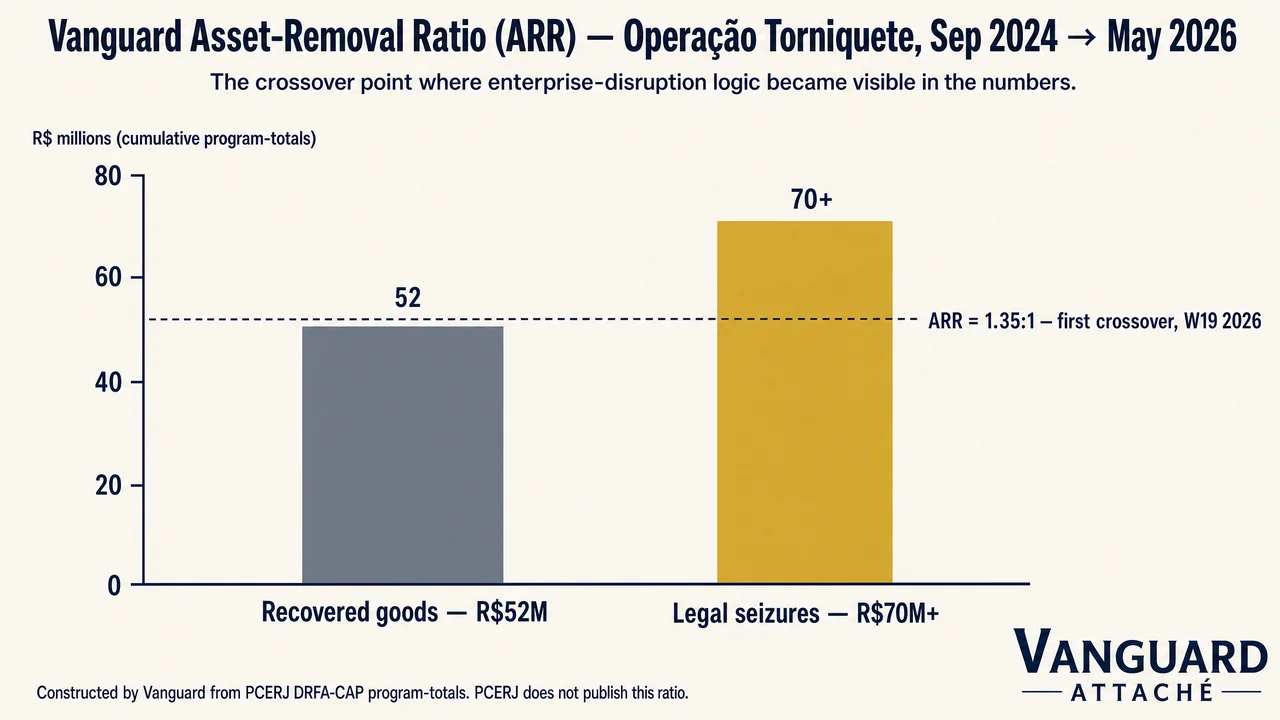
The program-aggregate numbers since September 2024 confirm the logic: 900+ prisões, approximately R$52M in goods recovered, R$70M+ in legal seizures. Read those three numbers in sequence and the theory of the case becomes visible — the seizures column is larger than the recovered-goods column. PCERJ is removing assets from the financial chain, not just confiscating what was stolen yesterday.
Wednesday 7 May — Operação Rede Cobre (PCERJ DRF / DGPE / CORE)
Eighty mandados, executed in parallel across Fallet-Fogueteiro, Morro dos Prazeres, Morro da Coroa, Niterói, Duque de Caxias, Magé, and Italva. The target was Comando Vermelho’s financial arm — explicitly. The instrument was the copper-receivership chain (stolen industrial copper bought, melted, and resold) and the gato-net infrastructure (clandestine internet and cable-TV resale, charging residents in CV-controlled territory for stolen utility services). The primary individual target was Paulo César Baptista de Castro — “Paulinho do Fogueteiro” — a man with 93 prior records.
One PC officer was wounded in the arm at the Fallet-Fogueteiro shootout; the wound was non-serious. One unidade primária de saúde at Morro dos Prazeres suspended attendance; two more halted external services; one school closed.
The Operação Contenção program totals (Rede Cobre is a sub-operation inside Contenção) read: 345 prisões, 137 mortes em confronto, 477 firearms seized including 190 fuzis, and more than 51,000 rounds of ammunition. Those are real numbers. But again — read the targeting alongside them. The press wrote “raid on Fallet-Fogueteiro” for the international wires. The case file reads “stolen-copper logistics + clandestine-utility billing.”
Thursday 8 May — PMERJ in Cidade de Deus + Gardênia Azul
The fourth day was a PM operation, not a PC operation, and the framing was barricade removal — 18º + 41º + 9º BPM with BOPE and BPVE support, entering CV-controlled Cidade de Deus and the militia-vs-CV-disputed Gardênia Azul. Gunfire was exchanged; no injuries reported at publication time; one state school suspended classes. This is the outlier of the four — a kinetic operation in the conventional sense, with conventional objectives. It belongs in the four-day window because every primary corridor between Galeão (GIG) and Zona Sul came under disruption pressure at some point across those four days, but the targeting logic differs from the prior three.
What sat across the week
The Linha Vermelha + Av. Brasil + Linha Amarela approach axes were intermittently disrupted across all four operating days. Forty-one schools, three health facilities, and nine bus lines lost full or partial service in a single Tuesday window. Three operations stacked on three consecutive days, hitting three distinct zones, with three distinct CV/TCP capability sets targeted — and the connective tissue across all three was enterprise infrastructure, not territory.
The one number that proves the pivot is real
Most readers of a Rio operations brief see two columns in the press totals: recovered goods and legal seizures. The Operação Torniquete program-aggregate (Sep 2024 → May 2026, sourced from PCERJ DRFA-CAP) carries both, and the relationship between them is where the thesis of this piece sits.
Vanguard Asset-Removal Ratio (ARR) — Torniquete, Sep 2024 → May 2026: 1.35:1.
Construction: R$70M+ in legal seizures (assets frozen, accounts seized, property attached under criminal forfeiture proceedings) divided by R$52M in recovered goods (stolen property physically returned to victims). The ratio crosses 1.0 for the first time in the program’s recorded history during the week of 5–8 May 2026. Through the prior week, the recovered-goods column led; this week, the seizures column does.
PCERJ does not publish this ratio. Vanguard Attaché constructs it from the program-totals column-by-column because the ratio is the only number that distinguishes confrontation-era policing from enterprise-era policing at the program-aggregate level. A barricade operation produces a recovered-goods number. A spreadsheet operation produces a seizures number. When the seizures number exceeds the recovered-goods number, the case files have stopped being about what was stolen yesterday and started being about what the cell owns.
The raw program-totals are public — PCERJ publishes them in DGPE press notes. The longitudinal comparison — when did the columns cross, and against which sub-operation — requires a maintained record of every Contenção sub-operation back to September 2024. That record is what we call our intelligence vault: the internal aggregation of every primary-source incident report we maintain for São Paulo and Rio, week by week. That maintained record is what makes the ratio defensible. Anyone can divide R$70M by R$52M. Few can tell you when the columns first crossed.
What two-touch corridor confirmation looks like on a real Tuesday morning
Here is what two-touch corridor confirmation actually looks like — not as a checklist, but as the decision your driver and your route-clearer make together on a Tuesday morning when a Maré perimeter clear is about to take Linha Vermelha out for two hours.
On Tuesday 6 May, we had a principal landing at GIG Terminal 2 at 11:25 BRT — fifteen minutes before BPVE began the perimeter clear that produced the 11:40–13:35 Linha Vermelha closure. The driver was CID-trained, two years on the corridor. The vehicle was a Suburban — low-profile spec, no armoring, no follow car. A boards-and-hotels week. Here is the decision chain we ran — and the version of it your team should be running, with the names of your operators in place of ours.
We had pulled the route on Monday afternoon, not Tuesday morning, because of the prior-week carry-forward: Torniquete Phase 1 had given us a procedural fingerprint — DRFA-CAP locks a Maré perimeter mid-morning, the closure runs roughly 90 to 120 minutes, BPVE clears Linha Vermelha both directions, and the recovery profile favors Linha Amarela south rather than Av. Brasil. Phase 2 was the predictable event of the week, not the surprise. The Saturday 3 May synthesis entry in our intelligence vault flagged the operational halo on Maré as the likeliest disruption surface for the week to come. By Monday afternoon we had a Linha Amarela alternative pre-cleared with the driver, the hotel notified, and the principal’s host on a one-line WhatsApp that read: “We may shift route entry; will confirm 30 min prior.” That is the entire pre-arrival memo. No deck.
At 11:10 BRT Tuesday — twenty minutes before wheels-down — I texted the driver one line: “Linha Amarela. Confirm.” He acknowledged in forty seconds. The principal cleared customs at 11:38 BRT, the Suburban pulled off the GIG arrivals ramp at 11:51 BRT, and the principal was in the Copacabana hotel by 12:34 BRT — twenty-six minutes faster than the original Linha Vermelha estimate would have run on a clean day, because Linha Amarela was lighter than usual (the Linha Vermelha closure was displacing traffic toward Av. Brasil, not Linha Amarela). The driver did not see the closure happen. We had routed him around it before it happened.
This is what a “two-touch corridor confirmation regime” looks like in practice. It is not a checklist. It is a Monday-afternoon pre-clear plus a twenty-minute pre-arrival text, anchored on a vault entry written three days earlier. The cost is one operator-hour of route work the day before and forty seconds of driver attention on the morning. The avoided cost is your principal sitting on Linha Vermelha for one hour and fifty-five minutes, with no comms, in a closed corridor, while the BPVE clear runs.
Three things made it possible. First, the prior week’s Torniquete Phase 1 entry in the vault — without that procedural baseline, Phase 2 reads as a surprise. Second, the Saturday synthesis entry — without that, Tuesday morning is a scramble. Third, the driver discipline: a one-line text returned in forty seconds, no debate, no callback. None of those three pieces exist without an operating tempo set in 2024 and refined every week since. Your team can build the same three pieces; what matters is that they exist before the Tuesday text needs to be sent.
The strategic answer to what does the enterprise-targeting pivot change for principals is “the case calendar runs the corridor calendar.” The operational answer is one principal, one Suburban, and one text message that ran twenty minutes ahead of a road closure — because someone had read three weeks of primary-source attestations on a Saturday morning.
— Arthur Harris, founder; former LAPD officer and U.S. Army Reserve CID/Protective Service Battalion veteran.
Identifying details (client name, role, exact hotel, business purpose) have been altered or omitted to protect client confidentiality. Operational facts — the corridor decision, the timing, the route taken, the driver’s response time — are unchanged. This is one arrival, not a composite.
The pivot you need to understand, in one sentence
PCERJ has stopped chasing the street and started chasing the spreadsheet.
The street-level confrontation continues — the dead suspect at Maré, the wounded PC officer at Fallet-Fogueteiro, the closed Linha Vermelha — but it is now the perimeter of the case, not the case itself. The case is the shell company. The case is the digital marketplace. The case is the fraudulent loan opened in a victim’s name three days after their phone was stolen on Av. Brasil. The kinetic moment is what it costs to get to the ledger.
That is a different theory of policing than what international coverage of Rio operations has been carrying for a decade. It is also a different theory of what to be afraid of — for a principal, for a family-office security counsel, and for anyone writing a Q2 Brazil-risk slide for a board pack.
Three things this changes for executive protection
1. “Phone theft” is no longer a device-loss event. It is a personal-data-and-banking-app exposure event with a multi-week tail. The Operação Rastreio file proves the chain end-to-end: phone robbed → unlocked at São Carlos → personal data harvested → Pix transfers, fraudulent loans, banking-app authentication abuse. The São Paulo data from the prior month adds the bookend: 1,464 phones stolen in the Pinheiros 14º DP subdistrict alone, January–February 2026. Your pre-trip phone-discipline brief now needs a 72-hour post-incident response playbook attached: Pix-block within 1h, SIM-block within 2h, banking-app device unenroll within 4h, written police BO within 24h. Your CP team should carry a printed laminated card with named-bank emergency lines (Itaú / Bradesco / Banco do Brasil / Santander / Nubank) and the principal’s personal bank pre-loaded.
2. The GIG ↔ Zona Sul corridor reliability profile now requires two-touch confirmation on any morning departure during a PCERJ enterprise-targeting cycle. The 11:40–13:35 Linha Vermelha closure window during Torniquete Phase 2 is the modal recovery profile, not the exception, when BPVE is clearing the roadway. Across the four-day window, every primary corridor between the international airport and the Zona Sul came under disruption pressure at some point. The standing one-touch Waze-only pre-confirmation is no longer adequate for these cycles. The current standard is Waze + COR-Rio + (where available) the local BPM social channel for Maré-side, with a confirmed Linha Amarela alternative pre-cleared for any Maré-side disruption and an Av. Niemeyer / Túnel Rebouças alternative pre-cleared for any Zona-Sul-side disruption.
3. The corridor disruption pattern will continue for as long as the financial-targeting cycle runs. This is the strategic point. If PCERJ’s case files are now built on twelve-month-plus investigations into shell-company networks and clandestine digital platforms, the operational tempo is set by the case calendar, not by media cycles or political pressure. Operação Contenção’s program totals (345 prisões, 137 mortes em confronto, 477 firearms across multiple sub-operations) tell a story of sustained pacing. Principals with regular Brazil exposure should plan for further four-day clusters at irregular intervals through the 2026 calendar — not as crisis events, but as operating background.
Three things this does not change
1. The kinetic risk to your principal moving through Zona Sul, Itaim, Faria Lima, or Ipanema during a normal business day is unchanged. The week’s operations occurred in Maré, Fallet-Fogueteiro / Prazeres / Coroa, São Carlos, and Cidade de Deus. None of those are addresses on a normal client itinerary. Corridor effects are real (Linha Vermelha, Av. Brasil) but they are corridor effects — pre-cleared alternatives handle them.
2. The “low-profile sedan + CID-trained driver + route discipline” doctrine still wins. Nothing in the week’s evidence argues for armored-vehicle escalation on a standard SP-or-RJ business itinerary. If the strategic threat has moved from confrontation to enterprise crime, the principal-vehicle implication points the other direction — visibility and predictability remain the larger risks for a hotels-restaurants-offices week.
3. The off-duty-police friction vector is the more immediate behavioral risk for the next 30 days. Our weekly synthesis carries a separate cluster from the same week — three off-duty police lethal-force events in three consecutive days across both cities (Morumbi, Rua Alba/Jabaquara, Pechincha/Taquara) with two civilian fatalities. The traffic-friction → escalation → lethal-force vector that produced both civilian fatalities is the one your CP team can actually train against this week. The PCERJ enterprise-targeting story is strategically louder; the off-duty-police-friction story is tactically louder. Both are true at once.
Three signals your team should watch for through end of May
1. The nine-day window after a Maré phase. Early-stage chatter in our intelligence backlog suggests territorial reassertion typically follows a major Maré operation by roughly nine days. If your principal is in Rio between 15 May and 17 May, that window overlaps the Argus Rio Crude arrival ramp (18–20 May). The corridor overlay your team is using should be re-run the day the conference hotel is confirmed. We re-run ours on that trigger; yours should be on a similar one.
2. The Contenção program’s next sub-operation. Rede Cobre executed Wednesday 7 May. If the program-pacing pattern holds, the next discrete sub-operation lands within 14–21 days — late May. Watch for an enterprise-targeting move against digital-platform receivership (the natural successor to copper-receivership in the asset-removal logic). When it lands, expect corridor effects across whichever zone is targeted; bake a two-touch confirmation regime into any same-day GIG ↔ Zona Sul movement that week.
3. The cross-state warrant pattern. Operação Rastreio executed Rio-led São Paulo-side warrants on Day 1. If a second cross-state operation lands in the next quarter, the policing-doctrine shift is confirmed — and the question your team should be asking is whether your São Paulo itinerary needs the same corridor pre-clears your Rio itinerary already gets. If no second cross-state operation lands by end of Q3, treat Rastreio as a notable single-event rather than a doctrinal turn.
The three numbers that translate into a Q2 board-pack risk slide
If you run point on a family-office or corporate Brazil-exposure portfolio, three numbers from this week’s operations translate cleanly into a Q2 board-pack slide: 13,300+ devices recovered and 870+ arrests on Operação Rastreio (TCP, phone-theft → banking-fraud chain); 900+ prisões and R$52M+ recovered on Operação Torniquete since September 2024 (CV, shell-company enterprise); 345 prisões and 477 firearms across the broader Operação Contenção program. Forward this piece to your in-house security counsel — they will want the program-totals breakdown for the slide. We maintain the underlying vault and can answer specific corridor questions on the same day.
Ready to Secure Your Brazil Trip?
Complete our security assessment to receive a custom protection plan built around your itinerary, your destinations, your risk profile and your travel dates.