
What you need to know first
Motorcycle-approach armed robbery is the durable threat to a single-occupant private car moving through São Paulo’s affluent corridors. It has one operational signature, and one reliable countermeasure: how the driver moves in the first three seconds of the approach. This brief is that countermeasure, catalogued so a principal’s driver, close-protection lead, or self-driving family member can hold it in mind before the next trip.
In May 2026, two fatal cases 48 hours apart made the pattern legible enough to teach from. A forty-year-old man named Leandro Fernandes de Souza was shot in the chest on Sunday 17 May at 21:30 in Vila Andrade, after his off-duty police officer brother had already yielded a phone and Leandro reacted. A retired Globo television helicopter pilot in his seventies named Odailton "Dato" de Oliveira Silva was shot in the head on Tuesday 19 May at 15:30 in Butantã near Rio Pequeno, after reacting to a motorcycle approach, with no belongings taken from him before he died. Two single-occupant private cars. Two residential-adjacent arterials. Two motorcycle approaches with one or two assailants, 48 hours apart. Two moments of victim resistance. Two fatal gunshot wounds: one to the head (Butantã), one to the chest (Vila Andrade); in Butantã nothing was taken from the victim, in Vila Andrade only the off-duty brother’s phone.
Those two cases sat against an April antecedent: GCM officer Sara Andrade dos Reis, killed 19 April 2026 on the high-speed Rodovia dos Imigrantes. Her case was structurally different. She was on her own motorcycle, on a freeway, and her service pistol was taken, so it does not belong inside the private-car signature. But it shows the same motorcycle-approach lethality was already live across the wider Q2 exposure before the private-car pattern concentrated in the affluent corridors.
Read as evidence rather than as news, these cases do two things for a planner. They fix the signature precisely enough to brief on, and they show a geographic creep westward across the two May cases that widened the zone worth reviewing. The protocol that follows is the one we teach every Vanguard Attaché principal driver, every close-protection team member, and every family member who drives themselves in São Paulo’s affluent perimeter. And the reason the discipline matters is not that we expect to lose a watch. It is that the principal still walks into the 9:00 Faria Lima board meeting they flew in for, on time. The advance route review and the closed São Paulo operator network are what keep that arrival window, and the door, open through this perimeter; the in-car discipline below is what makes that access dependable. Here is the protocol.
What the signature actually looks like
Both May 2026 cases share these characteristics. We catalogue the pattern explicitly so the brief is unambiguous to your driver and your close-protection lead.
The vehicle and movement profile. Single-occupant private car. No convoy. No driver-and-principal pair. No close-protection escort. The principal-as-driver: in both cases the principal-figure as driver of their own non-armored vehicle. The street class is the second element: residential-adjacent arterial, not the high-speed freeway. Rua do Símbolo in Vila Andrade is a side street one block off the high-density Av. Vitacon residential corridor at the Morumbi-Vila Andrade boundary. Av. do Rio Pequeno number 700 in Butantã is a moderate-speed local arterial that connects the Butantã residential band to the Pinheiros river corridor. Neither May case was on the high-speed Marginal Pinheiros sentido Interlagos artery itself. Speed at the moment of approach was moderate, allowing the motorcycle to close.
The approach profile. Always a motorcycle. One or two assailants. The Vila Andrade descriptions were specific: a beige Yamaha Ténéré with one assailant wearing a pink-and-black helmet. The Butantã description was a black motorcycle with one assailant. The motorcycle is the constant; the make, color, and helmet detail vary.
The interaction sequence. In both cases, the victim attempted some form of resistance rather than full passive yield. In Vila Andrade the off-duty police officer brother had already yielded his phone; Leandro reacted. In Butantã the retired pilot may have reacted to the approach; preliminary accounts suggested resistance, though the security-camera footage could not confirm it. In each case the resistance preceded the shot.
The outcome profile. Head or chest gunshot wound: one head (Butantã), one chest (Vila Andrade). In Butantã nothing was taken from the victim before the assailant left the scene; in Vila Andrade the off-duty officer’s phone had already been taken. Both fatal at the scene or in transport to hospital.
The geographic creep. Through April, the affluent-corridor pattern looked like a São Paulo-Sul anchor: Morumbi, Vila Andrade. With the Tuesday 19 May Butantã case, the perimeter extended westward by approximately five to seven kilometers, picking up the Butantã, Rio Pequeno, Jaguaré, and Vila Sônia residential bands. The corridor connecting Morumbi to Butantã runs through residential neighborhoods that are continuous on both sides of Av. Eng. Heitor Antônio Eiras Garcia.
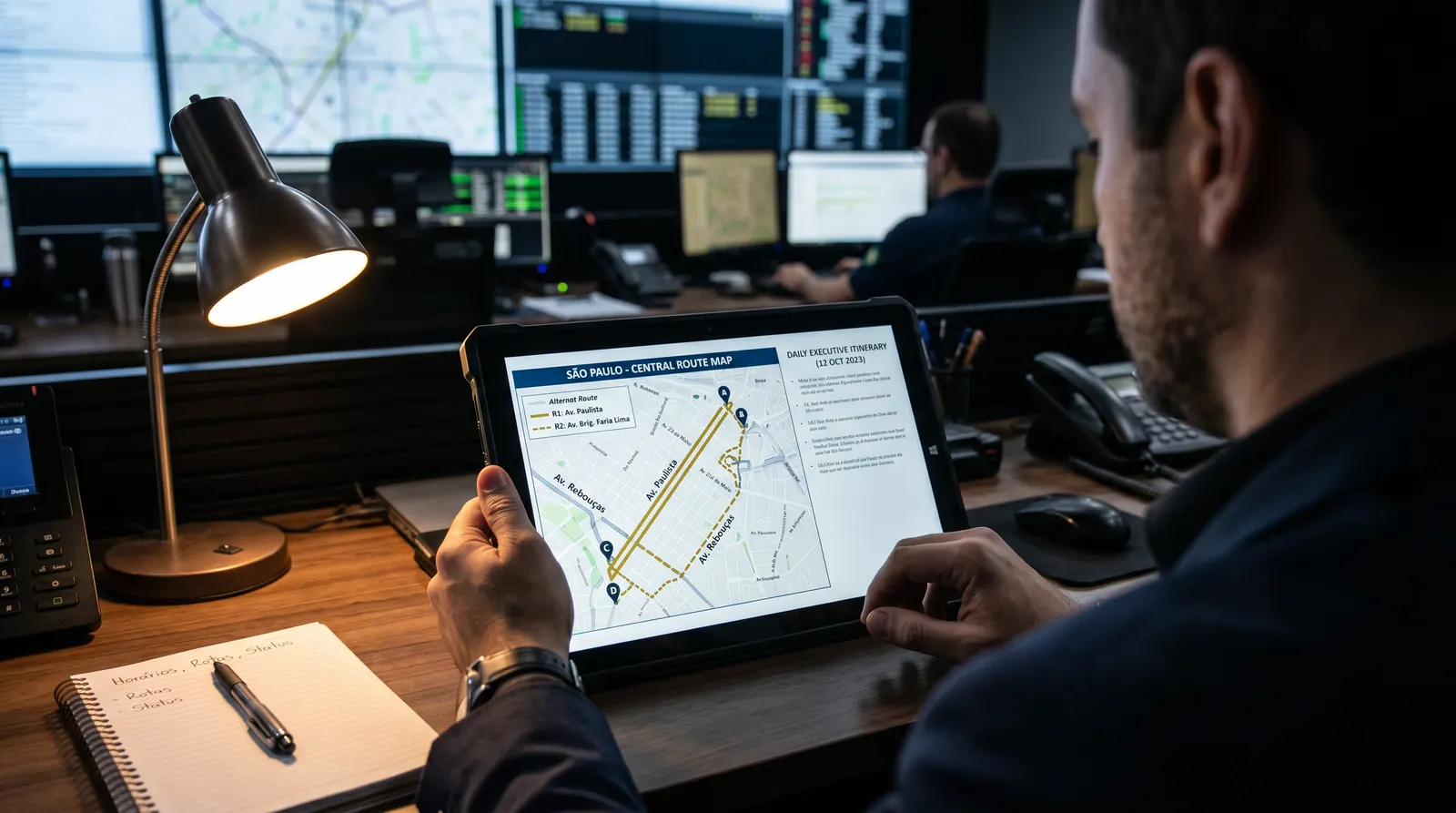
The protocol: how your driver should move
Brief your driver, your close-protection team, and your principal-as-driver on the following. This is the protocol we teach Vanguard principal drivers. The point of every element is the same: it keeps the principal’s movement through the affluent corridor uninterrupted, so the arrival the trip was built around still happens on schedule. There are five elements; the first one is the most important.
- One. On any motorcycle approach in an affluent-perimeter arterial, yield immediately. Do not brake-check. Do not horn. Do not turn your head to look at the assailant. Do not reach for the door handle. Do not reach for the glove box. Do not reach for the lock-defeat button. Slow the vehicle gradually to a stop. Place both hands visibly on the wheel, palms forward, fingers spread. Do not speak unless spoken to. Comply with the phone, watch, or wallet demand. Once the assailant has departed, remain stationary for thirty seconds before pulling away.
- Two. At a signal stop, scan your mirrors continuously for any motorcycle entering the twenty-meter envelope behind your vehicle. This is the most common moment of approach. Keep your phone off the dashboard and out of the cupholder. Keep your watch hand on the wheel, not on the door. If a motorcycle enters the envelope and slows behind you, lower your window posture (do not open the window) and assume a yield posture before the light changes. If the light changes before the approach completes, ease into traffic gradually; do not accelerate sharply away from the motorcycle.
- Three. For your principal as passenger, the protocol applies equally. The principal should not lean toward the door window when traffic is stationary. The principal should not be looking down at a phone in their hand when the vehicle is in residential-arterial movement. If your principal carries a high-value watch, brief them that on motorcycle approach the watch hand stays on their lap, not on the door rest. The wisdom of the principal’s standing yield brief (yield immediately, accept the loss) carries forward with extra weight here.
- Four. For family members driving themselves, the discipline applies in the same form. Pre-trip review: phone on the lap, screen off, not on the seat or in the cupholder. Valuables in the glove box, not visible from the window. No bag on the passenger seat. No door-pocket-visible items that suggest target value. Signal-stop attentiveness includes a continuous mirror scan for any motorcycle within twenty meters. The Vila Andrade victim was the brother of an off-duty police officer; the Butantã victim was alone. Both were perimeter-zone residents driving in familiar neighborhoods. The familiarity is not protective.
- Five. Accept the loss. Two affluent-corridor private-car fatalities in 48 hours, with a fatal April antecedent on the same motorcycle-approach vector, say the resistance window has closed for the São Paulo affluent-corridor private-car class of engagement. A phone can be replaced in twenty-four hours. A watch can be replaced in a quarter. A wallet can be reissued in a week. The principal cannot be replaced. The principal’s child cannot be replaced. This is the protocol Vanguard teaches without softening.
Ready to Secure Your Brazil Trip?
Complete our security assessment to receive a custom protection plan built around your itinerary, your destinations, your risk profile and your travel dates.
The perimeter zones that need this brief
We require pre-trip route review on these zones for any single-vehicle Vanguard movement and any principal-as-driver brief:
The arterials inside this perimeter that carry the most motorcycle-approach exposure are Av. do Rio Pequeno, Av. Engenheiro Heitor Antônio Eiras Garcia, Av. Giovanni Gronchi, Av. Morumbi, Av. Diogo de Faria, Av. Brigadeiro Faria Lima, Av. Cidade Jardim, Av. 9 de Julho, and Av. Faria Lima cross-streets in Itaim. Marginal Pinheiros sentido Interlagos is the high-speed artery; the private-car signature concentrates on the residential-adjacent arterials, not the freeway itself, but the Marginal stays on the standing watchlist from the separate freeway-modality case.
If your principal is staying at an Itaim, Pinheiros, or Jardins luxury property (a Hotel Unique sitting inside a conference delegate-arrival corridor is the recurring case), the access we provide is the dependable movement between that property and every affluent-corridor meeting, dinner, and venue on the itinerary: pre-cleared primary and alternate routes, advance perimeter review on each, and a São Paulo operator network that keeps the arrival window open even when a corridor has to be re-routed around a live signature. If your family member resides in any of these neighborhoods and drives themselves to school, work, or social engagements, the same perimeter brief and the same advance-route support apply to their movements.
What this is not
This is not a "São Paulo is dangerous" story. São Paulo at the macro level remains at a twenty-five-year robbery low. The Q1 2026 Security Secretariat statistics support the broad reassurance most country desks already give. The reason this signature is worth a dedicated brief is that the cases are operationally specific (same vehicle profile, same arterial class, same approach, same victim-reaction outcome), and the geographic creep in May widened the zone Vanguard considers in scope. The macro picture has not reversed. The micro signature has crystallized.
This is also not a "stop driving in the affluent perimeter" story. Vanguard principals will continue to live, work, and move through the same fourteen-neighborhood perimeter as before. The brief is how your driver and your close-protection team move through it, not whether they do.
What the pattern signals
Two things determine how aggressively a planner should hold this brief: whether the signature broadens, and whether it narrows. Both are worth watching, and the protocol stands either way.
The broadening case is the one to plan against. Fresh cases inside the same perimeter, or the adjacent northeastern zones (the Pinheiros / Vila Madalena boundary, Sumaré, Higienópolis), would confirm the private-car signature as a standing posture rather than a cluster, and would pull those adjacent zones formally into scope. That is why the northeastern boundary already earns standing pre-trip review even though the documented May cases sit further west and south.
The narrowing case changes the tone, not the discipline. A quiet stretch with no fresh cases in the perimeter calibrates the briefing tone downward and eases the urgency of the family-member-driver brief, but the in-car protocol does not change. The signature is cheap to keep in a driver’s standing repertoire and expensive to relearn under a motorcycle at a signal stop, so it stays in the brief regardless of the month’s count.
The steady-state read is that motorcycle-approach robbery remains a standing-context element of the São Paulo principal brief rather than a one-time bulletin. The fourteen-neighborhood perimeter above is the durable scope; we extend it only when a fresh case lands outside it. For the current month-by-month macro picture that sits behind this signature, our rolling São Paulo security report carries the up-to-date read.
The signature dataset
We are publishing the aggregate as a citable dataset rather than leaving it as paragraph references. The perimeter map above and the table below are the same data in two forms. Each row is anchored to a vault-side incident file and a public-record event description. The first two rows are the May private-car signature; the third is the structurally-distinct April antecedent, included as context, not as a third instance.
| # | Date | Neighbourhood · City | Role | Approach · Outcome |
|---|---|---|---|---|
| 1 | 2026-05-17 | Vila Andrade (Rua do Símbolo), São Paulo | May signature | Fatal chest gunshot after victim reaction; off-duty PM brother’s phone taken |
| 2 | 2026-05-19 | Butantã / Rio Pequeno (Av. do Rio Pequeno 700), São Paulo | May signature | Fatal head gunshot after reaction to approach; nothing taken from the victim |
| 3 | 2026-04-19 | Rodovia dos Imigrantes (freeway), São Paulo | April antecedent (context) | Fatal; service pistol taken. Structurally distinct: context, not a signature instance |
A machine-readable copy of these rows is available at /datasets/sao-paulo-affluent-corridor-motorcycle-robbery-2026.json (CC BY 4.0). Journalists, researchers, and security operators who want the raw aggregate can pull it directly.
Take this into your next São Paulo planning conversation
Save this for your next São Paulo trip planning conversation with your executive assistant, and forward it to your close-protection lead so the perimeter list updates this week. If your principal drives themselves, or your family member drives themselves inside the perimeter, the protocol above is the brief: read it directly into the next pre-trip conversation. And if you would rather the arrival simply be handled (routes pre-cleared, perimeter reviewed, the principal at the Faria Lima door on time without a family member carrying the protocol themselves), that is the movement Vanguard Attaché runs through this corridor every week. Start that conversation before the next São Paulo trip, not after the next signature.