
What is the safest way to arrange an airport transfer in Brazil?
Key Insight
For most executive travelers, a pre-arranged private transfer at $50-80 USD per airport pickup eliminates the majority of arrival-related risk. The difference between an unplanned arrival and a prepared one is typically $50-80 USD and 15 minutes of advance coordination.
Why This Guide Exists
Here is a statistic that reframes how you think about landing in Brazil: transportation hubs account for 49.89% of all registered crimes in the São Paulo metropolitan area [SSP-SP, 2024]. Not the favelas. Not the nightclubs. The places where travelers are at their most disoriented — pulling luggage, checking phones, searching for ground transportation — are where nearly half of all metropolitan crime concentrates.
For business travelers and executives, this means the 30 to 90 minutes between touching down and arriving at your hotel represent the most consequential security decision of your entire trip. And yet, most corporate travel policies treat ground transportation as an afterthought — a line item on an expense report rather than a risk variable that needs active management.
This guide covers Brazil's three major international gateways — Guarulhos (GRU) in São Paulo, Galeão (GIG) in Rio de Janeiro, and Presidente Juscelino Kubitschek (BSB) in Brasília — with route-level, data-backed analysis that generic travel advisories simply do not provide. You will learn:
- Why each airport demands a different transfer strategy — and what happens when you treat them as interchangeable
- The specific highway corridors where incidents concentrate, with shooting data from the Fogo Cruzado Institute
- A 5-tier comparison framework ranking every transfer option from Uber to armored SUV, with current pricing
- How time of day shifts your risk profile and what that means for your flight booking
- The strategic routing alternative for Rio that bypasses its most dangerous corridor entirely
Why Airport Transfers Are Brazil's Highest-Risk Moment
The vulnerability window explained
Every executive protection professional recognizes a concept called the "vulnerability window" — the period when a traveler's exposure to risk is highest and their ability to respond is lowest. In Brazil, that window opens the moment you clear customs.
You are carrying luggage that signals international travel. You are likely holding a phone with GPS and maps visible. You may not speak Portuguese. You are unfamiliar with local traffic patterns, route options, and neighborhood boundaries. If you arrived on an overnight flight — common from North America and Europe — fatigue further reduces your situational awareness.
This combination of visible foreignness, reduced alertness, and predictable location (the airport exit) is precisely what opportunistic criminals exploit. Express kidnappings (sequestro relâmpago) in Brazil have increased approximately 30% over the past five years, with criminals now exploiting the PIX instant payment system to extract funds within minutes of capture [OSAC, 2024]. The airport-to-hotel corridor is where that risk peaks.
Common Threats by Airport Type
Taxi & Ride-Hailing Scams
Over 20% of São Paulo taxis reportedly operate without proper registration [Brazilian Police reports, 2024]. Unregistered drivers may use rigged meters, take circuitous routes, or serve as intelligence gatherers for robbery crews.
Traffic-Based Vulnerability
São Paulo's Marginal Tietê regularly grinds to a halt during peak hours (7-10 AM, 5-8 PM). Extended time stationary in traffic creates opportunities for arrastão-style robberies — coordinated street-level theft targeting vehicles stuck in congestion.
Corridor Violence
Concentrated in Rio de Janeiro. The Linha Vermelha highway connecting GIG to Zona Sul passes through favela-adjacent areas. In October 2025, police operations resulted in 121 deaths and shut down the Linha Vermelha entirely. Airlines activated emergency rebooking protocols [ISP-RJ, 2025].
Cell Phone Theft
Brazil recorded 850,800 stolen cell phones in 2024 [ANATEL, 2024]. The arrival hall and taxi queue are prime locations for opportunistic theft targeting disoriented travelers.
São Paulo GRU — Transfer Security Assessment
Brazil's busiest gateway: manageable with preparation
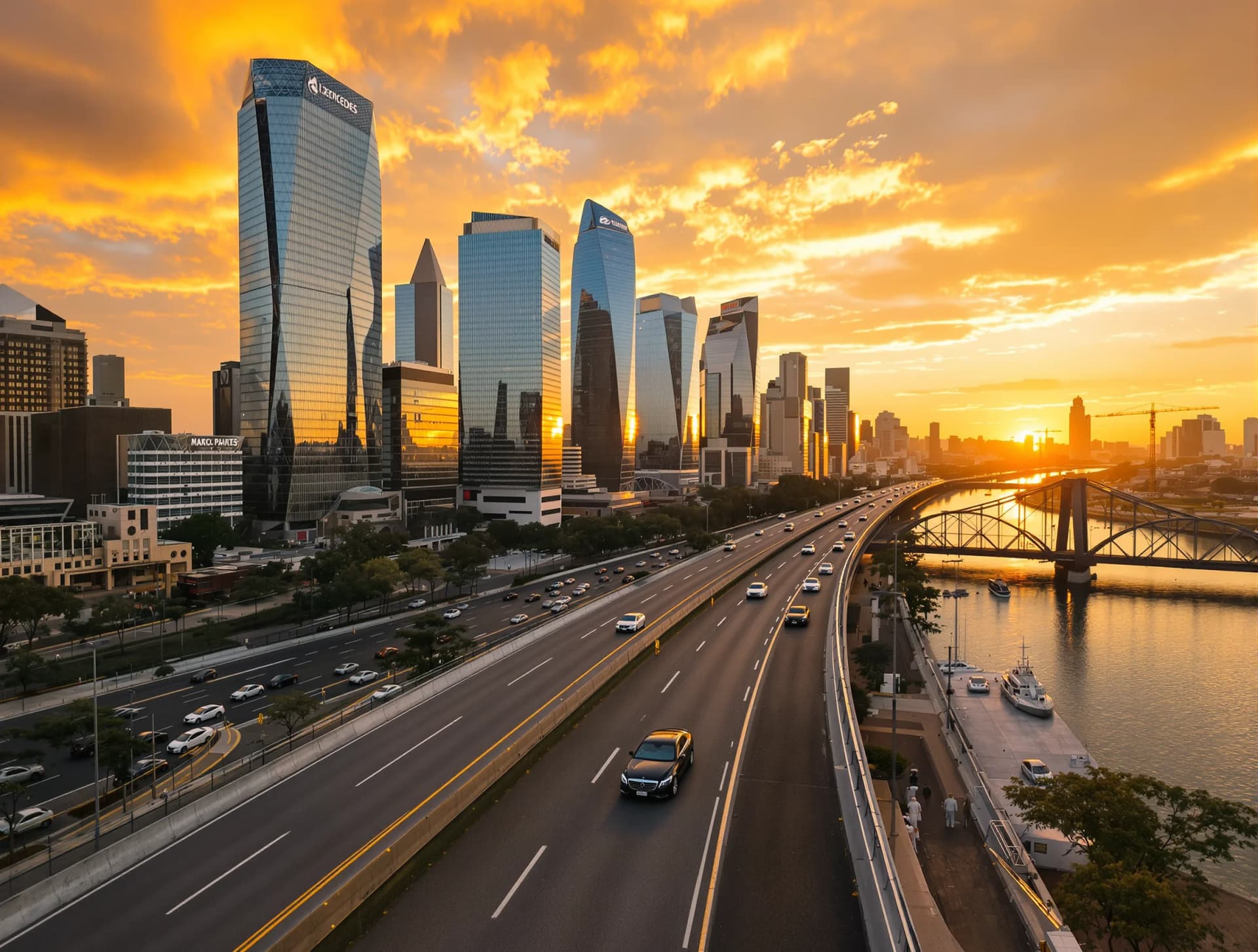
GRU: 26km to SP business center, 30 min without traffic
São Paulo's Guarulhos International Airport (GRU) is Brazil's busiest gateway and the most common entry point for business travelers. The standard route from GRU follows the Rodovia Presidente Dutra to the Marginal Tietê, connecting to the Jardins, Itaim Bibi, and Faria Lima business districts. Under normal conditions, the drive takes approximately 30 minutes. During peak hours — weekdays between 7-10 AM and 5-8 PM — that same route can stretch to 1 hour and 45 minutes [GRU Airport, 2025].
São Paulo state achieved the lowest homicide rate among all Brazilian states at 5.7 per 100,000 in 2024, three times below the national average of 17.1 [SSP-SP, 2024]. Vehicle robbery in the state declined 9.5% between 2022 and 2023 [SSP-SP, 2023]. The primary risk at GRU is not violent crime — it is the combination of scam exposure, traffic-based vulnerability during congestion, and the difficulty of identifying legitimate transportation.
Timing Recommendation
If your flight arrives between 10 AM and 4 PM, or after 8 PM, you benefit from lighter traffic and a faster, lower-exposure transfer. Early morning arrivals (5-7 AM) are also favorable. The worst window is 5-8 PM weekday arrivals.
Transfer Options at GRU
Official Airport Taxi (Guarucoop)
R$60-90 (~$12-18 USD)Designated taxi ranks reduce exposure to non-registered drivers. The cooperative is the official airport partner. Budget-friendly with baseline verification.
Uber / 99
R$100-250 (~$20-50 USD)Brazil is Uber's largest global market. Adequate for daytime transfers to established business districts. Verify the driver's photo, name, and license plate before entering the vehicle.
Pre-Arranged Private Transfer
$50-80 USDRecommended tier for most executive travelers. A vetted, English-speaking driver meets you inside the terminal with a name sign, handles luggage, and follows a pre-determined route.
The GRU General Aviation Terminal (GAT)
For ultra-high-net-worth travelers or those with specific security concerns, GRU offers a General Aviation Terminal that bypasses the commercial terminals entirely. You clear immigration and customs in a private lounge with dedicated staff. The cost is $2,450 USD per direction [GRU Airport, 2025] — significant, but it eliminates all terminal-level exposure. Typically paired with an armored vehicle transfer.
Rio de Janeiro GIG — Navigating Brazil's Most Complex Transfer
Route security is the primary challenge
GIG: Routes to Zona Sul pass through corridors with documented incidents
The Linha Vermelha Problem
The primary highway from GIG to Zona Sul is the Linha Vermelha (Red Line). This elevated highway passes through or adjacent to several favela communities, including Complexo da Maré. In 2024, the Fogo Cruzado Institute documented 7 shooting incidents on the Linha Vermelha corridor [Fogo Cruzado Institute, 2024].
The alternative route, Avenida Brasil, recorded 52 shooting incidents in the same period [Fogo Cruzado Institute, 2024]. This means the primary ground alternative is significantly worse from a security standpoint.
In October 2025, large-scale police raids in the Complexo do Alemão and Penha communities shut down the Linha Vermelha entirely. Airlines activated emergency rebooking protocols. This illustrates why Rio transfers require advance planning with a provider who monitors real-time corridor conditions.
2024 Corridor Shooting Incidents (Fogo Cruzado Institute)
7
Linha Vermelha shootings (2024)
52
Avenida Brasil shootings (2024)
Source: Fogo Cruzado Institute, which has recorded over 63,000 shooting incidents since 2016
The Santos Dumont (SDU) Strategic Alternative
Here is the routing decision most travel managers and security consultants overlook: Santos Dumont Airport (SDU) sits just 2 km from Rio's financial center and Zona Sul, with a transfer time under 15 minutes to most hotels [transit data, 2025]. SDU serves domestic flights from São Paulo (Congonhas), Brasília, and other Brazilian cities. If your itinerary includes a connecting flight through São Paulo or Brasília, booking the domestic leg into SDU instead of GIG eliminates the Linha Vermelha corridor from your trip entirely.
When SDU Works
Domestic connections, multi-city Brazilian itineraries, travelers who prioritize transfer security over direct international arrival.
When GIG Is Unavoidable
Direct international flights, which only land at GIG. In this case, pre-arranged secure transfers with a provider who monitors the Linha Vermelha in real time are essential rather than optional.
Transfer Options at GIG
Prepaid Taxi Kiosk (Inside Arrivals)
R$100-180 (~$20-36 USD)Fixed pricing and documented driver assignment — a meaningful step above hailing a taxi outside. Plus tolls to Zona Sul.
Uber / 99
Similar to prepaid kioskAvailable at GIG with similar pricing. The same driver verification protocols apply: confirm identity before entering.
Pre-Arranged Private Transfer
$60-100 USDThe minimum recommended tier for GIG. A professional driver who knows the corridor, monitors for police operations, and can reroute in real time. Essential for night arrivals.
Secure Executive Transfer
quoted before engagementAppropriate for travelers with elevated profiles or multi-day Rio itineraries. Includes a trained security driver, advance route planning, and real-time operations center coordination.
Brasília BSB — The Straightforward Transfer
Lowest risk profile of Brazil's three major gateways
Brasília's Presidente Juscelino Kubitschek International Airport (BSB) offers the most straightforward transfer environment. The city's planned grid layout, lower crime rates, and shorter distances reduce both logistical complexity and security exposure. Brasília's homicide rate stands at 7.7 per 100,000 — well below the national average of 17.1 [FBSP, 2024].
The hotel sector (Setor Hoteleiro) sits just 15 km from BSB, with a normal transfer time of approximately 20 minutes [BSB Airport, 2025]. The safe zones for business travelers — Asa Sul, Asa Norte, Lago Sul, Lago Norte, and Sudoeste — are all within a compact corridor connected by wide, well-lit avenues.
15 km
Airport to hotel sector
20 min
Normal transfer time
7.7
Homicide rate per 100K (vs 17.1 national avg)
Key Precaution
The U.S. government designates satellite cities like Ceilândia and Santa Maria as Level 4 (off-limits) for U.S. personnel after 6 PM [OSAC, 2024]. If your hotel or meeting location falls outside the Plano Piloto, your transfer planning requires the same diligence as GRU or GIG.
Transfer costs are the lowest of the three airports. A taxi to the hotel sector runs approximately R$50-65 (~$10-13 USD). Pre-arranged private transfers start at $40-60 USD.
For most travelers to Brasília, a pre-arranged private transfer is a sensible precaution rather than a strict necessity — but it remains the recommended default, particularly for first-time visitors unfamiliar with the city layout.
The 5-Tier Transfer Comparison Framework
Match the right protection level to your profile
One of the most common questions Arthur Harris fields from clients is deceptively simple: "What level of transfer do I actually need?" Born and raised in São Paulo, with years of experience in U.S. law enforcement and Army CID criminal investigations, Harris developed this framework to match the right tier of protection to the right traveler profile — because over-securing is almost as counterproductive as under-securing.
Ride-Hailing App (Uber/99)
R$60-250 (~$12-50 USD)
Best for: Budget-conscious travelers, daytime transfers to established business districts, low-profile individuals
No driver vetting beyond app verification, surge pricing during peak hours, potential route unfamiliarity, no English guarantee. Adequate for GRU (daytime) and BSB (anytime). Not recommended for GIG night arrivals.
Official Airport Taxi
R$50-180 (~$10-36 USD)
Best for: Travelers who prefer fixed pricing and documented driver assignment
Drivers may not speak English, no advance route planning, no real-time monitoring. All three airports have official taxi programs. Guarucoop at GRU and prepaid kiosks at GIG provide baseline verification.
Pre-Arranged Private Transfer
Recommended$50-100 USD
Best for: Corporate executives, first-time visitors, families, anyone arriving on international flights
Vetted English-speaking driver, terminal meet-and-greet, pre-planned route, luggage assistance, fixed pricing, vehicle pre-inspection. Recommended minimum for all three airports. Essential for GIG night arrivals.
This is the sweet spot. For $50-80 USD — roughly the cost of a business lunch — you eliminate the scam risk, language barrier, and arrival disorientation that create most transfer incidents.
Secure Executive Transfer
quoted before engagement
Best for: Senior executives, individuals with public profiles, multi-day business trips requiring frequent ground movements
Trained security driver with route intelligence, advance reconnaissance, real-time operations center coordination, counter-surveillance awareness, luxury vehicle. Recommended for GIG (all hours), GRU (night arrivals or high-profile travelers), BSB (government-level meetings).
Armored Vehicle with Security Detail
Quoted before engagement, scaling with vehicle configuration and team size
Best for: UHNWIs, individuals with known threats, public figures, high-value cargo transport
Ballistic protection (typically NIJ Level III+), armed security personnel with Federal Police credentials, full advance work, secure communications, medical kit. Typically paired with GRU GAT ($2,450/direction) for complete terminal bypass.
Decision Guideline
If you cannot articulate a specific, credible threat scenario that justifies Tier 4 or 5, Tier 3 is almost certainly the right choice. Most executive travelers fall comfortably into Tier 3 — and that is a good thing, because it means Brazil's security environment is more manageable than headlines suggest.
Ready to Secure Your Brazil Trip?
Complete our security assessment to receive a custom protection plan built around your itinerary, your destinations, your risk profile and your travel dates.
Night vs. Day — How Timing Changes Everything
The difference is categorical, not incremental
Daytime Transfers
6 AM - 8 PM
Primary risks are traffic congestion (extending transit time) and petty crime (phone theft, taxi scams). Violent incidents during daytime transfers are uncommon on standard airport corridors. Tier 1-3 transfers are appropriate for most travelers. Peak traffic windows (7-10 AM, 5-8 PM) at GRU can add 60-75 minutes.
Night Transfers
8 PM - 6 AM
Vehicle robbery incidents increase. Police operations in Rio can shut down highway corridors without advance warning. Visibility is reduced. Brazil records an average of 932 daily vehicle theft and robbery incidents [FBSP, 2024]. GRU and GIG corridors see a disproportionate share.
Night Arrival Protocol
- Pre-arrange your transfer before landing — never rely on arrivals-hall taxis or walk-up ride-hailing after 10 PM
- Confirm your driver's identity through a secondary channel (text message or WhatsApp from the service provider) before exiting the terminal
- Minimize visible electronics and luggage exposure in the terminal
- At GIG specifically, ensure your provider monitors the Linha Vermelha for active incidents
Flight Booking Consideration
When possible, book daytime arrivals. A 2 PM landing at GRU followed by a 30-minute transfer in light traffic is a fundamentally different security proposition than a midnight landing followed by a 25-minute transfer through empty corridors. Same distance, same destination — very different risk environment.
7 Airport Transfer Mistakes That Put Executives at Risk
Each one is avoidable with minimal preparation
Accepting transportation offers inside the terminal
Individuals approaching you in the arrivals hall with "taxi?" or "transfer?" are not vetted. Some are legitimate freelancers; others are intelligence gatherers for robbery crews. Use official taxi ranks, app-based services, or your pre-arranged driver only.
Displaying company branding or conference badges during transit
A lanyard that reads "Global Finance Summit — São Paulo" tells an observer exactly who you are, where you are going, and what you are worth. Remove all identifying materials before exiting the secure area.
Counting or displaying cash at the terminal
Currency exchange at airport counters is necessary. Counting your Brazilian reais in the open arrivals hall is not. Handle cash discretely, distribute it across pockets, and keep your primary wallet out of sight.
Posting real-time arrival updates on social media
A LinkedIn post that says "Just landed in Rio for the week" establishes your location, your timeline, and the fact that your home is unoccupied. Delay all travel posts by at least 24 hours.
Choosing ground transportation based solely on price
The difference between a R$60 unverified taxi and a $60 USD pre-arranged private transfer is not $48 — it is the entire risk architecture of your arrival. In a high-stakes environment, the cheapest option is rarely the most economical.
Ignoring local time-of-day patterns
A transfer at 2 PM and a transfer at 11 PM along the same route present fundamentally different risk profiles. Failing to account for timing is one of the most common corporate travel oversights.
Using the same route and schedule repeatedly
For multi-day trips with daily transfers (hotel to office and back), predictable patterns create vulnerability. Professional drivers vary routes, departure times, and pickup locations to reduce predictability.
What to Do If Something Goes Wrong
Response protocols for common scenarios
Transfer vehicle compromised (breakdown, accident, or threat)
- Remain in the vehicle with doors locked unless directed otherwise by your driver
- Contact your service provider's operations center immediately
- If using a ride-hailing app with no backup, call 190 (Military Police) or 192 (ambulance)
Robbery attempt in traffic
- Comply. Do not resist. Material possessions are replaceable; your safety is not.
- Hand over phones, watches, and wallets without hesitation
- Avoid sudden movements or reaching into bags unexpectedly
- File a police report (boletim de ocorrência) at the nearest delegacia afterward — required for insurance claims and consular assistance
Route blocked by police operation (particularly at GIG)
- Your driver should have alternative routing. If they do not, remain stationary with windows up until traffic resumes.
- Do not attempt to exit the vehicle or reroute on foot
- Contact your hotel to advise of the delay
- This scenario is precisely why pre-arranged transfers with situationally aware drivers are worth the investment
The U.S. State Department maintains a Level 2 advisory for Brazil ("Exercise Increased Caution"), updated in March 2026 to specifically reference kidnapping [U.S. State Department, 2026]. Register with the Smart Traveler Enrollment Program (STEP) before your trip for real-time alerts and consular access.
Your Pre-Arrival Checklist
The data tells a clear story: airport transfers are the single most consequential security decision of any Brazil trip, but they are also one of the easiest risks to manage. The difference between an unplanned arrival and a prepared one is typically $50-80 USD and 15 minutes of advance coordination.
Transfer pre-booked with a vetted service provider — not a day-of decision
Driver identity confirmed through a secondary channel (WhatsApp, email)
Route awareness — know the primary and alternative routes to your destination
Timing optimized — daytime arrivals when possible, especially at GIG
Emergency contacts saved — service provider operations center, hotel, consulate (U.S. Consulate: +55-11-3250-5000 in SP, +55-21-3823-2000 in Rio)
STEP enrollment completed — U.S. citizens register at step.state.gov
Brazil's three major airports each present a distinct challenge. São Paulo's GRU demands traffic management and scam prevention. Rio's GIG requires route-level security awareness and flexible planning. Brasília's BSB rewards basic preparation with a straightforward experience. Match the right transfer tier to your profile, and you will move through each gateway with the kind of calm confidence that allows you to focus on why you traveled to Brazil in the first place.
If you are planning a trip and want a personalized transfer recommendation based on your specific itinerary, arrival time, and profile, our team can build a complete ground transportation plan in under 24 hours.
Ready to Secure Your Brazil Trip?
Complete our security assessment to receive a custom protection plan built around your itinerary, your destinations, your risk profile and your travel dates.
Sources cited
- SSP-SP — Secretaria de Segurança Pública de São Paulo (49.89% transport hub crime, 5.7/100K homicide rate, vehicle robbery decline)
- Fogo Cruzado Institute (7 Linha Vermelha shootings, 52 Avenida Brasil shootings in 2024; 63,000+ incidents since 2016)
- ISP-RJ — Instituto de Segurança Pública do Rio de Janeiro (October 2025 police operations)
- FBSP — Fórum Brasileiro de Segurança Pública (National homicide rate 17.1/100K, Brasília 7.7/100K, 932 daily vehicle thefts)
- OSAC — Overseas Security Advisory Council (Express kidnapping trends, PIX exploitation, Brasília satellite city restrictions)
- ANATEL — Agência Nacional de Telecomunicações (850,800 stolen cell phones in 2024)
- GRU Airport — Aeroporto Internacional de Guarulhos (Transfer times, GAT pricing)
- U.S. State Department — Brazil Travel Advisory
Frequently Asked Questions
Common questions about secure airport transfers in Brazil
Frequently Asked Questions
Is it safe to take Uber from GRU airport?
For daytime transfers to established business districts like Jardins, Itaim Bibi, or the Faria Lima corridor, Uber is an adequate option for most travelers. Brazil is Uber's largest global market, and the platform provides driver identification, GPS tracking, and trip sharing features. Always verify the driver's photo, name, and license plate before entering the vehicle. For night arrivals or transfers to less familiar areas, upgrade to a pre-arranged private transfer. Uber does not vet drivers to the same standard as professional transfer services, and there is no guarantee of English-speaking drivers.
How much does a secure airport transfer cost in Brazil?
Transfer costs range across five tiers. Ride-hailing apps (Uber/99): R$60-250 (~$12-50 USD). Official airport taxis: R$50-180 (~$10-36 USD). Pre-arranged private transfers: $50-100 USD per pickup. Secure executive transfers with trained security drivers: quoted before engagement. Armored vehicles with full security detail: quoted before engagement, scaling with vehicle configuration and team size. For most executive travelers, the $50-80 USD private transfer tier delivers the best balance of security and cost.
What is the safest way to get from GIG airport to my hotel?
The safest approach depends on your profile and timing. For the majority of travelers, a pre-arranged private transfer ($60-100 USD) with an English-speaking driver who monitors the Linha Vermelha corridor in real time is the recommended minimum. For travelers with elevated profiles or night arrivals, a secure executive transfer (quoted before engagement) adds trained security awareness and advance route planning. The strategic alternative: if connecting through São Paulo or Brasília, book your domestic leg into Santos Dumont Airport (SDU), which sits just 2 km from Rio's hotel districts and bypasses the Linha Vermelha entirely.
Do I need an armored car from the airport in Brazil?
Most executive travelers do not. Armored vehicles (quoted before engagement) are appropriate for individuals with public profiles that create targeting risk, net worth exceeding $10 million with visible wealth indicators, extended stays with predictable daily patterns, or active security threats. If none of these apply to you, a Tier 3 pre-arranged private transfer ($50-80 USD) or Tier 4 secure executive transfer (quoted before engagement) provides sufficient protection. Over-securing can actually increase your visibility and draw unwanted attention — a low-profile approach is more effective in Brazil's urban environment.
What are the common airport taxi scams in Brazil?
The most frequent scams include: rigged or "broken" meters that inflate fares; drivers taking intentionally circuitous routes to increase the fare; unofficial drivers posing as licensed taxi operators — reportedly over 20% of São Paulo taxis operate without proper registration [Brazilian Police reports, 2024]; fixed-rate quotes that significantly exceed the standard fare; and distraction techniques where a second person engages you while the driver adjusts the route or price. Using official airport taxi cooperatives (Guarucoop at GRU, prepaid kiosks at GIG) or pre-arranged transfers eliminates exposure to all of these.
How long does it take to get from GRU to downtown São Paulo?
The distance from GRU to the central business districts (Avenida Paulista, Jardins, Faria Lima) is approximately 26 km. Under normal traffic conditions, the drive takes around 30 minutes via the Rodovia Presidente Dutra and Marginal Tietê [GRU Airport, 2025]. During peak hours — weekdays between 7-10 AM and 5-8 PM — the same route can stretch to 1 hour and 45 minutes. Mid-day arrivals (10 AM - 4 PM) and late evening arrivals (after 8 PM) typically see the fastest transfer times. For domestic connections, São Paulo's Congonhas Airport (CGH) sits just 8 km from the business districts with significantly shorter transfers.
Is the road from GIG airport to Copacabana dangerous?
The primary route from GIG to Copacabana passes along the Linha Vermelha highway, which the Fogo Cruzado Institute documented as having 7 shooting incidents in 2024. The alternative Avenida Brasil route recorded 52 shooting incidents in the same period [Fogo Cruzado Institute, 2024]. Context matters: these incidents are distributed across an entire year on highways serving hundreds of thousands of daily vehicles. The per-trip risk is low, but for executive travelers the incidents are concentrated enough to warrant a pre-arranged transfer with a driver who monitors real-time conditions and can reroute if a police operation or security incident develops along the corridor.
What is the safest airport in Brazil for business travelers?
Among Brazil's three major international gateways, Brasília's BSB offers the lowest risk profile. The city's homicide rate is 7.7 per 100,000 [FBSP, 2024] — well below the national average of 17.1 — and the 15 km transfer to the hotel sector takes approximately 20 minutes through well-maintained government-district infrastructure. São Paulo's GRU ranks second: despite being Brazil's busiest airport, São Paulo state has the lowest homicide rate of any Brazilian state at 5.7 per 100,000 [SSP-SP, 2024], and the primary transfer risks are traffic and scams rather than violence. Rio's GIG presents the highest transfer risk due to the Linha Vermelha corridor security environment.
Should I pre-book airport transfers in Brazil?
Yes — for every airport, at every tier above basic ride-hailing. Pre-booking eliminates the three highest-risk moments of an unplanned arrival: the decision point (standing in arrivals wondering what to do), the transaction point (negotiating with an unknown driver), and the verification gap (entering a vehicle without confirmed identity). A pre-arranged transfer means your driver is confirmed, your route is planned, and your exposure time at the terminal is minimized. This applies equally to GRU, GIG, and BSB.
Is Brasília airport safe?
BSB is the most straightforward of Brazil's three major gateways. The transfer to the Plano Piloto hotel sector covers just 15 km through planned, well-lit avenues, typically completed in 20 minutes [BSB Airport, 2025]. Brasília's compact government-district layout and lower crime rates make it the lowest-risk transfer environment. The one precaution: if your destination is in a satellite city (Ceilândia, Santa Maria, Estrutural), the risk profile increases substantially. The U.S. government designates these areas as Level 4 for U.S. personnel after 6 PM [OSAC, 2024]. Stay within the Plano Piloto and you are in one of Brazil's safest urban environments.
What is the difference between a private transfer and executive protection?
A private transfer (Tier 3, $50-100 USD) provides a vetted, English-speaking driver with a pre-planned route and terminal meet-and-greet. This addresses logistical risk — scams, language barriers, route unfamiliarity. Executive protection (Tier 4-5, quoted before engagement) adds active security capability: trained drivers with counter-surveillance skills, real-time operations center coordination, advance route reconnaissance, and — at Tier 5 — armored vehicles and armed personnel. The distinction is between a professional car service with security awareness and an active security operation that happens to include transportation.
Can I use public transportation from Brazilian airports?
The U.S. government discourages municipal bus use for official personnel traveling in Brazil [OSAC, 2024]. GRU offers an express bus service (Airport Bus Service) to Avenida Paulista, and BSB has public bus connections. While these are not inherently dangerous, they present challenges for business travelers: no luggage security, no English signage, crowded conditions that facilitate pickpocketing, and extended transit times. For executive travelers, the modest cost of a private transfer ($50-80 USD) makes public transportation an unnecessary exposure.
Related Services
Transportation and security solutions for your Brazil trip
Airport Transfers
Professional transfer service with vetted drivers
ServiceExecutive Transportation
Trained security drivers for executives
ServiceExecutive Protection
Armed coverage via Polícia Federal–authorized local partners
ServiceTravel Risk Assessment
Personalized analysis for your itinerary and profile