
What does São Paulo’s security data mean for a business visit?
We withdrew the wrong conclusion from our own guide
Our earlier guide described São Paulo as safer for executives by drawing on broad crime totals. We checked that conclusion again and withdrew it. The published figures were not a study of executives. We also removed neighborhood safety grades and promises of fixed journey times that the evidence did not establish.
For this revision, we matched the city, reporting month, crime category and comparison year before calculating a change. We retained the source numbers alongside the calculation, so a reader can reproduce it. That is a narrower claim than “safe for executives,” and a more useful foundation for a decision.
We made a second editorial choice: a vehicle’s protection label will no longer stand in for a claim about the whole service. Provider authorization, the documented vehicle specification and the passenger’s requirements answer different questions. A good proposal should let the buyer inspect each one.
Falling citywide crime totals are useful context; they are not a safety rating for an executive’s visit.
The current comparison we can substantiate
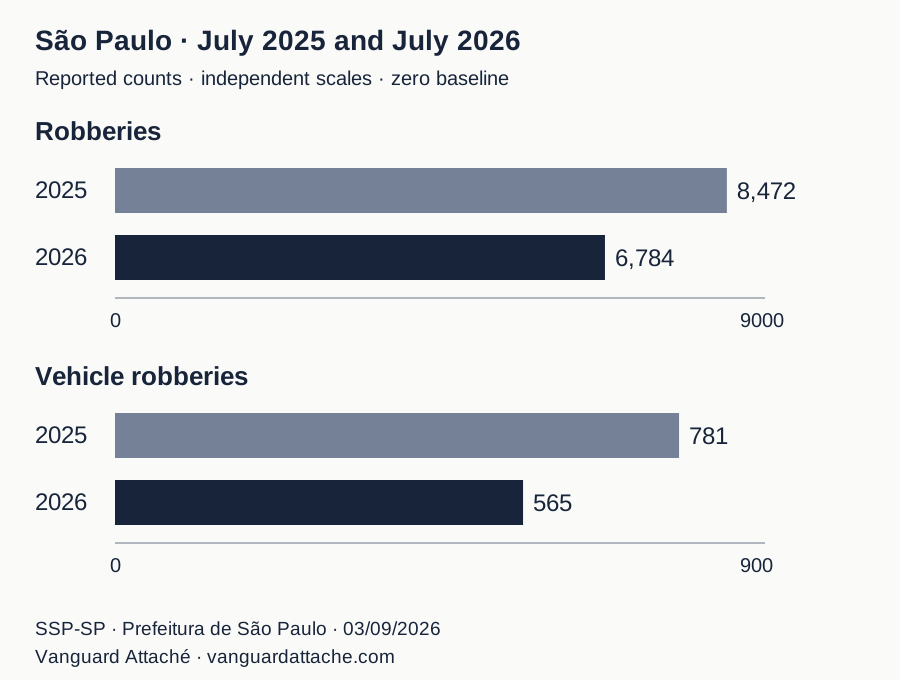
The municipal security secretariat’s September 3, 2026 release reports SSP-SP figures for the city of São Paulo in July 2026, compared with July 2025. Its total robbery count is 6,784 versus 8,472 (2026 versus 2025); vehicle robbery is 565 versus 781. São Paulo municipal security secretariat: July figures.
| Reported category | July 2025 | July 2026 | Change calculated from the stated counts |
|---|---|---|---|
| Robberies | 8,472 | 6,784 | −19.9% |
| Vehicle robberies | 781 | 565 | −27.7% |
Method: (2026 count − 2025 count) ÷ 2025 count × 100, rounded to one decimal. The denominator is the prior-year count for the same category and city-month. We did not add the categories together. They are reported police counts, not crimes per visitor, per journey or per hour of exposure. Underreporting and changes in reporting can affect interpretation.
The release describes vehicle robbery as down 27.6%. The counts printed in that same release yield 27.7% when rounded to one decimal. We display our calculated result and retain the publisher’s percentage in the downloadable data. We have not silently “corrected” the source or substituted a different count.
The source is public; the comparison and this reconciliation are our work. The chart uses a separate count scale for each category, with zero shown. Bar lengths must not be compared across the two panels. The underlying JSON retains the source URL, period, geography, counts and formula.
What the numbers change—and what they leave open
The two categories declined in this comparison. Two categories moving together says nothing about categories the release does not break out, or about any individual’s exposure. It is also a reason to be precise: a favorable comparison does not establish the likelihood of an incident affecting a visitor.
A city total combines different locations and circumstances. Without exposure data, dividing that total by visitors, residents or booked journeys would manufacture a rate the source does not provide. Nor can a city-month comparison establish that one hotel or neighborhood is suitable for a particular person.
For the assistant responsible for the visit, this distinction is practical. Use the figures as background. Use the passenger’s requirements, the actual destination arrangements and current advice to define the service. We would reject both an unsupported “all clear” and a sales pitch that turns a city count into a personal threat prediction.
Keep the business purpose at the center
A working visit to Faria Lima, an exhibition at a convention venue and a dinner with local colleagues place different demands on a booking. The relevant questions begin with participation: what commitments matter, what has been confirmed, and what assistance the passenger needs to take part comfortably.
State accessibility, language and group requirements early. Ask how changes in the commercial schedule affect the booking. An assistant should be able to explain the scope to the traveler in a short confirmation, without passing on a catalogue of equipment or an unsupported promise of an effortless trip.
Transport, building access and event admission are separate confirmations. A car reservation does not establish a meeting invitation. Protection does not confer access to a private venue. Keep those distinctions visible so that each part of the visit has a responsible provider or host.
Check the business behind the protection offer
The Federal Police provides a public company-regularity service. Anyone can use a legal name or CNPJ to consult the status of a private-security company. The service page was updated July 24, 2026. Check the business delivering the security service, including when a separate company coordinates the booking. Federal Police: company regularity.
That lookup addresses authorization. It does not establish that every capability in a proposal exists, or that a particular vehicle or individual is assigned. Ask for the evidence relevant to the scope you are purchasing. If the provider changes, the old check should not be treated as verification of the replacement.
We would not use a familiar brand name, a uniform or an armored-vehicle photograph as a substitute for knowing who holds responsibility. Discreet service and clear accountability are compatible. The buyer should not need to choose between them.
Compare the proposal on decisions you can verify
| Decision | A useful confirmation | A claim that still needs evidence |
|---|---|---|
| Who delivers the security service? | Legal entity and current regularity check | “Our trusted team will handle everything.” |
| What vehicle is proposed, if one is required? | Documented specification, passenger and luggage fit | A photograph standing in for an assigned vehicle |
| What does the booking include? | Written service scope, dates and exclusions | An undefined “complete package” |
| How are changes handled? | Waiting, amendment and cancellation terms | A promise that every delay is covered |
| What access has been confirmed? | Separate confirmation from the relevant host or venue | An assumption that transport includes admission |
This is a buyer’s comparison, not a prescription for staffing, routes or operating methods. Those decisions belong in the appropriate private assessment. The public guide should help the reader ask a better question without publishing an operational playbook.
A visit can be well prepared without being overpromised
The objective is to attend the meeting, take part in the event and spend time with the people you came to see. Ask the provider to explain how the proposed scope supports those priorities. A response that only adds equipment has not yet answered the question.
Begin with the city, dates, broad purpose and party requirements. Use the selected provider’s private process for further personal details. Confirm availability and scope before relying on a proposal. Prices should be quoted for that scope; a citywide crime percentage cannot establish the amount of service to buy.
Vanguard Attaché’s São Paulo executive-protection page provides the next step for discussing those requirements. This article offers source-based context and a booking framework. It does not certify an itinerary, rate a hotel or promise an incident-free outcome.
Questions about executive security in São Paulo
Is São Paulo safe for an executive visit?
A citywide yes-or-no label is too broad. The July comparison above describes reported city counts, not the risk to a particular person. Review the visit’s requirements and current evidence with the appropriate provider.
Does a decline in robberies mean protection is unnecessary?
The statistics cannot answer that by themselves. They provide context; they do not measure the exposure or requirements of the proposed visit.
How do I check a security company?
Use the Federal Police company-regularity service with the legal name or CNPJ of the company delivering the security service. Confirm that its identity matches the proposal.
Is a vehicle’s armor label enough to choose a service?
No. Verify the documented specification of the proposed vehicle and the wider service scope. Do not assume that labels from different protection standards are interchangeable.
Why does this guide show a different vehicle-robbery percentage from the source?
The publisher states 27.6%. Its printed counts, 781 and 565, calculate to a 27.7% decline when rounded to one decimal. Both values and the method are retained for transparency.
Sources checked September 14, 2026. The data compilation and editorial analysis are Vanguard Attaché’s; the underlying recorded counts are attributed to the stated public source. No client or operational records are used.